
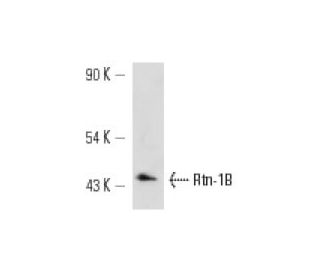

Rtn-1A/B Antibody (RNL-3): sc-53008
- Rtn-1A/B Antibody (RNL-3) is a mouse monoclonal IgG1 κ Rtn-1A/B antibody, cited in 3 publications, provided at 200 µg/ml
- raised against the small cell lung cancer cell line NCI-H82
- recommended for detection of Rtn-1A and Rtn-1B of human origin by WB, IP, IF and FCM; also reactive with additional species, including and rabbit and rhesus monkey
- available conjugated to either phycoerythrin or FITC for IF, IHC(P) and FCM
- m-IgG Fc BP-HRP, m-IgG1 BP-HRP and m-IgGκ BP-HRP are the preferred secondary detection reagents for Rtn-1A/B Antibody (RNL-3) for WB applications. These reagents are now offered in bundles with Rtn-1A/B Antibody (RNL-3) (see ordering information below).

Rtn-1A/B Antibody (RNL-3) is a mouse monoclonal IgG1 kappa light chain antibody that detects the Rtn-1A/B protein of human origin by western blotting (WB), immunoprecipitation (IP), immunofluorescence (IF), and flow cytometry (FCM). Anti-Rtn-1A/B antibody (RNL-3) is available in both non-conjugated and various conjugated forms, including phycoerythrin (PE) and fluorescein isothiocyanate (FITC). The Reticulon (Rtn) family, which includes Rtn-1, Rtn-2, Rtn-3, and Nogo, plays a crucial role in the structure and function of the endoplasmic reticulum, with Rtn-1 being particularly significant due to its involvement in neuroendocrine secretion and membrane trafficking. The Rtn-1 gene, located on human chromosome 14q23.1, produces three isoforms—Rtn-1A, Rtn-1B, and Rtn-1C—through alternative splicing, and these isoforms are predominantly expressed in neural and neuroendocrine tissues. The structural characteristics of Rtn-1 proteins, including their common C-terminal regions that anchor them to the endoplasmic reticulum membranes, are vital for maintaining cellular integrity and facilitating intracellular transport processes. Notably, Rtn-1A has emerged as a reliable marker for neuroendocrine differentiation in lung cancer, as its expression is frequently observed in small cell lung carcinoma and carcinoid tumors, highlighting its potential as a diagnostic tool in oncology. Rtn-1B exists in multiple forms, while Rtn-1C expression is closely associated with neuronal differentiation, further underscoring the importance of these proteins in both normal physiology and disease states.
Alexa Fluor® is a trademark of Molecular Probes Inc., OR., USA
LI-COR® and Odyssey® are registered trademarks of LI-COR Biosciences
Rtn-1A/B Antibody (RNL-3) References:
- Cloning of a novel member of the reticulon gene family (RTN3): gene structure and chromosomal localization to 11q13. | Moreira, EF., et al. 1999. Genomics. 58: 73-81. PMID: 10331947
- Identification of the Nogo inhibitor of axon regeneration as a Reticulon protein. | GrandPré, T., et al. 2000. Nature. 403: 439-44. PMID: 10667797
- Subcellular localization and supramolecular organization of neuroendocrine-specific protein B (NSP-B) in small cell lung cancer. | Senden, NH., et al. 1994. Eur J Cell Biol. 65: 341-53. PMID: 7720728
- NSP-encoded reticulons are neuroendocrine markers of a novel category in human lung cancer diagnosis. | van de Velde, HJ., et al. 1994. Cancer Res. 54: 4769-76. PMID: 8062278
- Molecular cloning of a novel mouse gene with predominant muscle and neural expression. | Geisler, JG., et al. 1998. Mamm Genome. 9: 274-82. PMID: 9530622
- Neuronal differentiation is accompanied by NSP-C expression. | Hens, J., et al. 1998. Cell Tissue Res. 292: 229-37. PMID: 9560466
- cDNA cloning, genomic organization, and expression of the human RTN2 gene, a member of a gene family encoding reticulons. | Roebroek, AJ., et al. 1998. Genomics. 51: 98-106. PMID: 9693037
Ordering Information
| Product Name | Catalog # | UNIT | Price | Qty | FAVORITES | |
Rtn-1A/B Antibody (RNL-3) | sc-53008 | 200 µg/ml | $322.00 | |||
Rtn-1A/B Antibody (RNL-3): m-IgG Fc BP-HRP Bundle | sc-536869 | 200 µg Ab; 10 µg BP | $361.00 | |||
Rtn-1A/B Antibody (RNL-3): m-IgGκ BP-HRP Bundle | sc-534037 | 200 µg Ab; 40 µg BP | $361.00 | |||
Rtn-1A/B Antibody (RNL-3): m-IgG1 BP-HRP Bundle | sc-544869 | 200 µg Ab; 20 µg BP | $361.00 | |||
Rtn-1A/B Antibody (RNL-3) FITC | sc-53008 FITC | 200 µg/ml | $336.00 | |||
Rtn-1A/B Antibody (RNL-3) PE | sc-53008 PE | 200 µg/ml | $349.00 |