
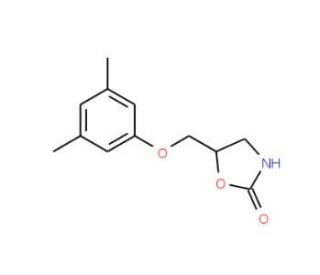

Metaxalone (CAS 1665-48-1)
QUICK LINKS
Metaxalone, a muscle relaxant structurally related to meprobamate, has garnered attention in scientific research primarily for its potential applications in the treatment of musculoskeletal disorders. Although its exact mechanism of action remains elusive, metaxalone is believed to exert its effects centrally through modulation of the central nervous system (CNS), particularly the spinal cord, rather than acting directly on skeletal muscle. Preclinical studies suggest that metaxalone may enhance the inhibitory neurotransmission mediated by gamma-aminobutyric acid (GABA) receptors, resulting in skeletal muscle relaxation. Additionally, metaxalone has been investigated in experimental models of pain management and muscle spasticity, demonstrating promising results in alleviating symptoms associated with various musculoskeletal conditions. Furthermore, metaxalone′s potential as an adjunct therapy in combination with other analgesic agents or muscle relaxants has been explored, aiming to improve overall treatment efficacy and patient outcomes. In the realm of basic science research, metaxalone serves as a valuable pharmacological tool for investigating the neurobiological pathways involved in muscle relaxation and pain modulation. Its selective actions on the CNS make it an attractive candidate for elucidating the complex mechanisms underlying neuromuscular physiology and pharmacology. Overall, metaxalone holds promise as a subject of scientific inquiry for understanding musculoskeletal pathophysiology and developing novel strategies for managing related disorders.
Metaxalone (CAS 1665-48-1) References
- Comparison of the dissolution of metaxalone tablets (Skelaxin) using USP Apparatus 2 and 3. | Cacace, J., et al. 2004. AAPS PharmSciTech. 5: E6. PMID: 15198527
- Commonly used muscle relaxant therapies for acute low back pain: a review of carisoprodol, cyclobenzaprine hydrochloride, and metaxalone. | Toth, PP. and Urtis, J. 2004. Clin Ther. 26: 1355-67. PMID: 15530999
- Adult metaxalone ingestions reported to Texas poison control centers, 2000-2006. | Forrester, MB. 2010. Hum Exp Toxicol. 29: 55-62. PMID: 19933254
- Serotonin syndrome associated with metaxalone overdose. | Bosak, AR. and Skolnik, AB. 2014. J Med Toxicol. 10: 402-5. PMID: 24805103
- A rare fatality attributed solely to metaxalone. | Curtis, B., et al. 2015. J Anal Toxicol. 39: 321-3. PMID: 25673649
- Postmortem Metaxalone (Skelaxin®) Data from North Carolina. | Bishop-Freeman, SC., et al. 2015. J Anal Toxicol. 39: 629-36. PMID: 26378137
- Monoamine oxidase A inhibition by toxic concentrations of metaxalone. | Cherrington, B., et al. 2020. Clin Toxicol (Phila). 58: 383-387. PMID: 31373522
- MAO-A Inhibition by Metaxalone Reverts IL-1β-Induced Inflammatory Phenotype in Microglial Cells. | Pallio, G., et al. 2021. Int J Mol Sci. 22: PMID: 34445126
- Conformational polymorphs of a muscle relaxant, metaxalone[J]. | Aitipamula S, Chow P S, Tan R B H. 2011. Crystal growth & design,. 11(9): 4101-4109.
- Solid phase behavior, polymorphism, and crystal structure features of chiral drug metaxalone[J]. | Bredikhin A A, Zakharychev D V, Gubaidullin A T. 2018,. Crystal Growth & Design,. 18(11): 6627-6639.
Ordering Information
| Product Name | Catalog # | UNIT | Price | Qty | FAVORITES | |
Metaxalone, 10 mg | sc-218699 | 10 mg | $227.00 |