
MEK-5 Lentiviral Ativação Partículas de ativação de lentivirus (h): sc-401688-LAC
- alvos específicos: human
- 200 µl de alto titulo de partículas de ativação lentiviral CRISPR/dCas9 prontas para a transdução of transduction-ready
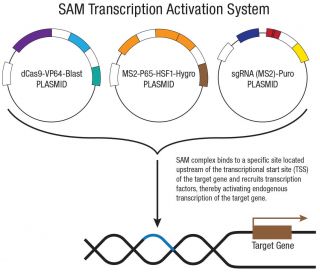
- MEK-5 as Partículas de Ativação Lentiviral (h) agem como um sistema de ativação de transcrição sinergética ao mediador de ativação (SAM, que foi criado para regular positivamente com especificidade e eficiência a expressão genética via transdução celular com lentivirus
- MEK-5 As partículas de ativação lentivirais (h) contem os seguintes elementos de ativação SAM:uma nuclease Cas9 (dCas9) desativada (D10A and N863A) ligadas a um domínio de transactivacao VP64, uma proteína de fusão MS2-p65-HSF1 e um alvo-especifico de RNA guia de 20 nt guia RNA. Ainda, as partículas contem genes de resistência a blasticidina, higromicina e puromicina
- Durante a transdução, o complexo SAM se liga a uma região especifica de aproximadamente 200-250 nt upstream da região de inicia da transcrição e assegura um recrutamento robusto de fatores de transcrição para uma eficiente ativação genética
- Os gRNAs codificados pelo MEK-5 Plasmídeo de Ativação Lentiviral (h) e pelo MEK-5 Plasmídeo de Ativação Lentiviral (h2) têm como alvo regiões reguladoras distintas do promotor MAP2K5. Um ou ambos os desenhos podem estar disponíveis
- Após a transfecção, a eficácia do processo de nocaute genético por ser testada WB, IF ou IHC usando o anticorpo: MEK-5 Anticorpo (E-3): sc-365198

Informacoes sobre ordens
| Nome do Produto | Numero de Catalogo | UNID | Preco | Qde | FAVORITOS | |
MEK-5 Lentiviral Ativação Partículas de ativação de lentivirus (h) | sc-401688-LAC | 200 µl | $455.00 | |||
MEK-5 Lentiviral Ativação Partículas de ativação de lentivirus (h2) | sc-401688-LAC-2 | 200 µl | $455.00 |
MAP2K5 codifica a MEK-5, uma quinase MAPK de dupla especificidade que atua a montante de ERK5 (MAPK7) para transmitir estímulos extracelulares para programas transcricionais que controlam a proliferação, a diferenciação e a sobrevivência celulares, bem como as respostas ao stress. A ativação de MEK-5 integra sinais de fatores de crescimento e de stress celular para regular efetores nucleares, incluindo fatores de transcrição da família MEF2, moldando assim a remodelação do citoesqueleto e fenótipos associados à migração. A desregulação do eixo MEK5–ERK5 tem sido associada a alterações na sinalização de crescimento e a comportamento invasivo em múltiplos contextos de doença, o que torna MAP2K5 um alvo frequente em estudos de mapeamento de vias e de genómica funcional. Como quinase nodal em cascatas de MAPK, a MEK-5 oferece um ponto de intervenção acessível para dissecar o crosstalk de sinalização e alterações subsequentes na expressão génica em células humanas.
As Partículas de Ativação Lentivirais MEK-5 (h) respondem a esta necessidade ao encapsular o sistema completo de ativação transcricional do mediador de ativação sinérgica (SAM) em partículas lentivirais de alto título, prontas para transdução, permitindo uma regulação positiva eficiente de MAP2K5 numa gama mais ampla de tipos de células humanas.
As Partículas de Ativação Lentivirais MEK-5 (h) fornecem todos os componentes funcionais do sistema mediador de ativação sinérgica (SAM) através da transdução lentiviral. O sistema compreende três preparações de partículas co-transduzidas em células-alvo: uma que codifica dCas9 cataliticamente inativo (mutações D10A e N863A) fundido ao domínio de transativação VP64 com um gene de resistência à blasticidina; uma que codifica a proteína de fusão MS2-p65-HSF1 com um gene de resistência à higromicina; e uma que codifica um sgRNA de 20 nt específico do alvo, fundido a dois aptâmeros de RNA MS2 com um gene de resistência à puromicina. Após a transdução lentiviral e a integração genómica das cassetes de expressão, os componentes do SAM são expressos de forma estável e reúnem-se no locus-alvo dentro da região promotora proximal a montante do local de início da transcrição MAP2K5, onde VP64, p65 e HSF1 atuam cooperativamente para recrutar a maquinaria transcricional endógena e impulsionar a regulação positiva sustentada da expressão endógena de MEK-5. A utilização de dCas9 inativo em termos de nuclease evita a introdução de quebras de DNA de cadeia dupla e preserva o locus genómico nativo MAP2K5 e a arquitetura reguladora.
O formato lentiviral oferece várias vantagens práticas: a integração genómica estável suporta a ativação hereditária ao longo das divisões celulares; as preparações de partículas de alto título eliminam a necessidade de produção viral interna; e a compatibilidade com tipos de células primárias, não divisíveis e resistentes à transfecção amplia a acessibilidade experimental. A transdução bem-sucedida pode ser confirmada e enriquecida através de seleção tripla com antibióticos utilizando puromicina, higromicina e blasticidina.
Apenas para uso em investigação. Não se destina a uso diagnóstico ou terapêutico.