
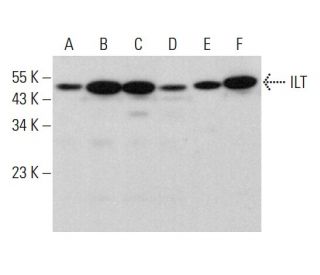


ILT Antibody (A-9): sc-166580
- ILT Antibody (A-9) is a mouse monoclonal IgG1 κ provided at 200 µg/ml
- raised against amino acids 162-461 mapping within an extracellular domain of ILT-2 of human origin
- recommended for detection of ILT famiy members 1, 2, 4, 5 and 6 of human origin, and the corresponding mouse and rat homologs by WB, IP, IF and ELISA
- m-IgG Fc BP-HRP and m-IgG1 BP-HRP are the preferred secondary detection reagents for ILT Antibody (A-9) for WB applications. These reagents are now offered in bundles with ILT Antibody (A-9) (see ordering information below).

ILT Antibody (A-9) is a mouse monoclonal IgG1 antibody that detects leukocyte immunoglobulin-like receptor (ILT) in mouse, rat, and human samples through applications such as western blotting (WB), immunoprecipitation (IP), immunofluorescence (IF), and enzyme-linked immunosorbent assay (ELISA). ILT proteins play a crucial role in the immune system, particularly in modulating immune responses, which is vital for maintaining immune homeostasis and preventing autoimmune diseases. These receptors are predominantly expressed on various immune cells, including monocytes, B cells, dendritic cells, and natural killer cells, and are found in tissues such as the placenta, lung, and liver. The ILT family is divided into two subfamilies: subfamily A, which includes ILT-1, ILT-6, ILT-7, ILT-8, ILT-11, and LIR-6, functioning primarily as stimulatory receptors, and subfamily B, which includes ILT-2, ILT-3, ILT-4, ILT-5, and LIR-8, serving as inhibitory receptors. The structural differences between these subfamilies are significant; for instance, subfamily A members possess transmembrane regions with charged arginine residues that initiate stimulatory signaling cascades, while subfamily B members contain immunoreceptor tyrosine-based inhibitory motifs (ITIMs) that trigger inhibitory pathways. Understanding the functional dynamics of ILT proteins is essential for developing therapeutic strategies aimed at modulating immune responses in various diseases. Anti-ILT antibody (A-9) is an invaluable tool for researchers investigating the complex roles of these receptors in immune regulation.
Alexa Fluor® is a trademark of Molecular Probes Inc., OR., USA
LI-COR® and Odyssey® are registered trademarks of LI-COR Biosciences
ILT Antibody (A-9) References:
- Pancreas cancer and the role of soluble immunoglobulin-like transcript 3 (ILT3). | Cortesini, R. 2007. JOP. 8: 697-703. PMID: 17993722
- Immunoglobulin-like transcript 3, an inhibitor of T cell activation, is reduced on blood monocytes during multiple sclerosis relapses and is induced by interferon beta-1b. | Jensen, MA., et al. 2010. Mult Scler. 16: 30-8. PMID: 20007427
- Expression of immunoglobulin-like transcript (ILT)2 and ILT3 in human gastric cancer and its clinical significance. | Zhang, Y., et al. 2012. Mol Med Rep. 5: 910-6. PMID: 22246571
- Immunoglobulin-like transcript receptors on human dermal CD14+ dendritic cells act as a CD8-antagonist to control cytotoxic T cell priming. | Banchereau, J., et al. 2012. Proc Natl Acad Sci U S A. 109: 18885-90. PMID: 23112154
- Downregulation of immunoglobulin-like transcript-4 (ILT4) in patients with psoriatic arthritis. | Bergamini, A., et al. 2014. PLoS One. 9: e92018. PMID: 24676037
- Co-expression of immunoglobulin-like transcript 4 and angiopoietin-like proteins in human non-small cell lung cancer. | Wang, L., et al. 2015. Mol Med Rep. 11: 2789-96. PMID: 25482926
- Immunoglobulin-like transcript 4 promotes tumor progression and metastasis and up-regulates VEGF-C expression via ERK signaling pathway in non-small cell lung cancer. | Zhang, P., et al. 2015. Oncotarget. 6: 13550-63. PMID: 25948790
- Immunoglobulin‑like transcript 4 and human leukocyte antigen‑G interaction promotes the progression of human colorectal cancer. | Cai, Z., et al. 2019. Int J Oncol. 54: 1943-1954. PMID: 30942436
- The expression and function of immunoglobulin-like transcript 4 in dendritic cells from patients with hepatocellular carcinoma. | Fan, J., et al. 2020. Hum Immunol. 81: 714-725. PMID: 33228921
- Tumor-Derived Immunoglobulin-Like Transcript 4 Promotes Postoperative Relapse via Inducing Vasculogenic Mimicry through MAPK/ERK Signaling in Hepatocellular Carcinoma. | Li, J., et al. 2024. Am J Pathol. 194: 2398-2411. PMID: 39233275
Ordering Information
| Product Name | Catalog # | UNIT | Price | Qty | FAVORITES | |
ILT Antibody (A-9) | sc-166580 | 200 µg/ml | $322.00 | |||
ILT Antibody (A-9): m-IgG Fc BP-HRP Bundle | sc-540124 | 200 µg Ab; 10 µg BP | $361.00 | |||
ILT Antibody (A-9): m-IgG1 BP-HRP Bundle | sc-541918 | 200 µg Ab; 20 µg BP | $361.00 |