
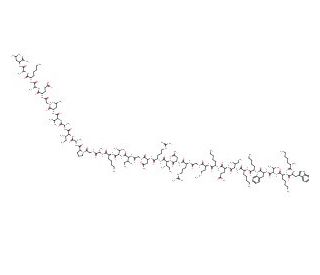

Cecropin B (CAS 80451-05-4)
QUICK LINKS
Cecropin B is an antimicrobial peptide (AMP) derived from the hemolymph of the cecropia moth, exhibiting potent activity against a wide range of bacteria, including both Gram-positive and Gram-negative species. Its mechanism of action involves disrupting bacterial cell membranes, leading to increased membrane permeability and cell lysis. Cecropin B interacts with the lipid bilayer of bacterial membranes, inserting itself into the membrane and forming pores. This pore formation compromises the integrity of the bacterial cell membrane, causing leakage of cellular contents and ultimately cell death. In research, cecropin B is extensively studied for its role in innate immune defense and its antimicrobial properties. It is used as a model peptide to investigate the structure-activity relationships of AMPs, providing valuable insights into how specific amino acid sequences and peptide structures influence antimicrobial efficacy. Researchers employ cecropin B in studies aimed at understanding the dynamics of membrane disruption and the kinetics of bacterial killing, as well as exploring the peptide′s selectivity for bacterial cells over eukaryotic cells. Moreover, cecropin B is utilized in synthetic biology and bioengineering to design and develop novel antimicrobial peptides with enhanced stability and efficacy. Studies often focus on modifying the peptide to improve its resistance to proteolytic degradation and to enhance its antimicrobial activity. The fundamental research on cecropin B significantly contributes to the development of new antimicrobial agents and the understanding of host-pathogen interactions, providing a basis for future innovations in combating bacterial infections.
Cecropin B (CAS 80451-05-4) References
- Cecropin B enhances betalactams activities in experimental rat models of gram-negative septic shock. | Ghiselli, R., et al. 2004. Ann Surg. 239: 251-6. PMID: 14745334
- Molecular cloning of cecropin B responsive endonucleases in Yersinia ruckeri. | Sallum, UW. and Chen, TT. 2011. Mar Biotechnol (NY). 13: 56-65. PMID: 20352273
- Cecropin B Represses CYP3A29 Expression through Activation of the TLR2/4-NF-κB/PXR Signaling Pathway. | Zhou, X., et al. 2016. Sci Rep. 6: 27876. PMID: 27296244
- Label-free liquid crystal biosensor for cecropin B detection. | Zhang, J., et al. 2018. Talanta. 186: 60-64. PMID: 29784409
- Enhanced Silkworm Cecropin B Antimicrobial Activity against Pseudomonas aeruginosa from Single Amino Acid Variation. | Romoli, O., et al. 2019. ACS Infect Dis. 5: 1200-1213. PMID: 31045339
- Cecropins in cancer therapies-where we have been? | Ziaja, M., et al. 2020. Eur J Pharmacol. 882: 173317. PMID: 32603694
- Activity of MSI-78, h-Lf1-11 and cecropin B antimicrobial peptides alone and in combination with voriconazole and amphotericin B against clinical isolates of Fusarium solani. | Denardi, LB., et al. 2021. J Mycol Med. 31: 101119. PMID: 33626413
- The cecropin-prophenoloxidase regulatory mechanism is a cross-species physiological function in mosquitoes. | Liu, WT., et al. 2022. iScience. 25: 104478. PMID: 35712072
- Hyaluronan-cecropin B interactions studied by ultrasound velocimetry and isothermal titration calorimetry. | Jugl, A. and Pekař, M. 2023. Int J Biol Macromol. 227: 786-794. PMID: 36549616
- A novel antibacterial approach of Cecropin-B peptide loaded on chitosan nanoparticles against MDR Klebsiella pneumoniae isolates. | Okasha, H., et al. 2023. Amino Acids. 55: 1965-1980. PMID: 37966500
Ordering Information
| Product Name | Catalog # | UNIT | Price | Qty | FAVORITES | |
Cecropin B, 100 µg | sc-394401 | 100 µg | $167.00 |