
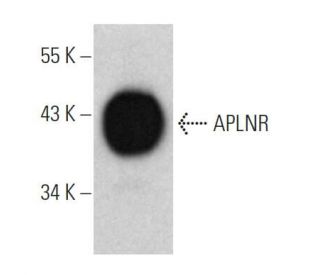

APLNR Anticuerpo (3C3-7): sc-517300
- APLNR Anticuerpo 3C3-7 es un monoclonal de ratón IgG1 κ APLNR Anticuerpo, ver las 8 publicaciones, proporcionado como 200 µg/ml
- frente a la recombinante APLNR de longitud completa de origen human.
- APLNR Anticuerpo (3C3-7) es recomendado para detectar APLNR de mouse, rat y human origen, mediante WB, IP, IF y IHC(P); también reactivo con otras especies, incluyendo anyd bovine, porcine, caprine and canine
- APLNR Anticuerpo (3C3-7) es disponible conjugado a agarosa para IP; HRP para WB, IHC(P) y ELISA; y tanto a phycoerythrin como a FITC para IF, IHC(P) y FCM
- también disponible conjugado a Alexa Fluor® 488, Alexa Fluor® 546, Alexa Fluor® 594 o Alexa Fluor® 647 para WB (RGB), IF, IHC (P) y FCM
- también disponible conjugado a Alexa Fluor® 680 o Alexa Fluor® 790 para WB (NIR), IF y FCM
- m-IgG Fc BP-HRP, 1 BP-HRP">m-IgG1 BP-HRP y m-IgGκ BP-HRP son los reactivos de detección secundarios preferidos para APLNR Anticuerpo (3C3-7) para aplicaciones WB e IHC(P). Estos reactivos se ofrecen ahora en paquetes con APLNR Anticuerpo (3C3-7)(véase la información de pedido más abajo).

ENLACES RÁPIDOS
VER TAMBIÉN ....
El anticuerpo APLNR (3C3-7) es un anticuerpo monoclonal IgG1 de ratón de cadena ligera kappa que detecta la proteína APLNR de origen de ratón, rata y humano mediante western blotting (WB), inmunoprecipitación (IP), inmunofluorescencia (IF) e inmunohistoquímica. El anticuerpo anti-APLNR (3C3-7) está disponible tanto en forma no conjugada como en varias formas conjugadas, incluyendo agarosa, peroxidasa de rábano picante (HRP), ficoeritrina (PE), isotiocianato de fluoresceína (FITC) y múltiples conjugados Alexa Fluor®. El receptor de apelina (APLNR) es un receptor acoplado a proteína G que desempeña un papel crucial en la regulación cardiovascular y la homeostasis energética. APLNR se localiza principalmente en el hipotálamo, donde APLNR está implicado en la modulación de las funciones neuroendocrinas, incluyendo la regulación del apetito y la presión arterial. La presencia de APLNR en células gliales, astrocitos y poblaciones neuronales específicas pone de relieve la importancia de APLNR en las vías de señalización del sistema nervioso central. El APLNR es activado por su ligando endógeno, la apelina, que conduce a la internalización del receptor y a los subsiguientes eventos de señalización que pueden inhibir la producción de AMPc, influyendo así en diversas respuestas fisiológicas. APLNR también sirve como un coreceptor alternativo para el VIH-1, lo que indica el papel multifacético de APLNR tanto en la salud como en la enfermedad. La comprensión de la localización y función de APLNR es esencial para dilucidar las contribuciones de APLNR a los trastornos metabólicos y cardiovasculares, haciendo del anticuerpo monoclonal APLNR (3C3-7) una herramienta valiosa para los investigadores que estudian estos procesos biológicos críticos.
Alexa Fluor® es una marca registrada de Molecular Probes Inc., OR., USA
REIVEW LI-COR® y Odyssey® son marcas registradas de LI-COR Biosciences.
APLNR Referencias:
- Clonación, caracterización farmacológica y distribución cerebral del receptor de apelina de rata. | De Mota, N., et al. 2000. Neuroendocrinology. 72: 400-7. PMID: 11146423
- Función fisiológica de un nuevo neuropéptido, la apelina, y su receptor en el cerebro de rata. | Reaux, A., et al. 2001. J Neurochem. 77: 1085-96. PMID: 11359874
- Expresión del ARNm del receptor APJ en el núcleo paraventricular hipotalámico de la rata: regulación por el estrés y los glucocorticoides. | O'Carroll, AM., et al. 2003. J Neuroendocrinol. 15: 1095-101. PMID: 14622440
- Localización nuclear independiente del agonista de los receptores de Apelina, angiotensina AT1 y bradicinina B2. | Lee, DK., et al. 2004. J Biol Chem. 279: 7901-8. PMID: 14645236
- Disociación funcional de la señalización del receptor de apelina y la endocitosis: implicaciones para los efectos de la apelina sobre la presión arterial. | El Messari, S., et al. 2004. J Neurochem. 90: 1290-301. PMID: 15341513
- Localización inmunocitoquímica del receptor de apelina, APJ, en cardiomiocitos humanos, músculo liso vascular y células endoteliales. | Kleinz, MJ., et al. 2005. Regul Pept. 126: 233-40. PMID: 15664671
Información sobre pedidos
| Nombre del producto | Número de catálogo | UNIDAD | Precio | CANTIDAD | Favoritos | |
APLNR Anticuerpo (3C3-7) | sc-517300 | 200 µg/ml | $322.00 | |||
Paquete de APLNR (3C3-7): m-IgG Fc BP-HRP | sc-531579 | 200 µg Ab; 10 µg BP | $361.00 | |||
Paquete de APLNR (3C3-7): m-IgGκ BP-HRP | sc-525308 | 200 µg Ab, 40 µg BP | $361.00 | |||
Paquete de APLNR (3C3-7): m-IgG1 BP-HRP | sc-544636 | 200 µg Ab; 20 µg BP | $361.00 | |||
APLNR Anticuerpo (3C3-7) AC | sc-517300 AC | 500 µg/ml, 25% agarose | $424.00 | |||
APLNR Anticuerpo (3C3-7) HRP | sc-517300 HRP | 200 µg/ml | $322.00 | |||
APLNR Anticuerpo (3C3-7) FITC | sc-517300 FITC | 200 µg/ml | $336.00 | |||
APLNR Anticuerpo (3C3-7) PE | sc-517300 PE | 200 µg/ml | $349.00 | |||
APLNR Anticuerpo (3C3-7) Alexa Fluor® 488 | sc-517300 AF488 | 200 µg/ml | $364.00 | |||
APLNR Anticuerpo (3C3-7) Alexa Fluor® 546 | sc-517300 AF546 | 200 µg/ml | $364.00 | |||
APLNR Anticuerpo (3C3-7) Alexa Fluor® 594 | sc-517300 AF594 | 200 µg/ml | $364.00 | |||
APLNR Anticuerpo (3C3-7) Alexa Fluor® 647 | sc-517300 AF647 | 200 µg/ml | $364.00 | |||
APLNR Anticuerpo (3C3-7) Alexa Fluor® 680 | sc-517300 AF680 | 200 µg/ml | $364.00 | |||
APLNR Anticuerpo (3C3-7) Alexa Fluor® 790 | sc-517300 AF790 | 200 µg/ml | $364.00 |