
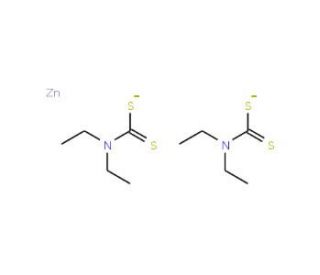

Zinc diethyldithiocarbamate (CAS 14324-55-1)
See product citations (1)
QUICK LINKS
Zinc diethyldithiocarbamate (ZDDC), an organo-metallic compound, has found extensive use in scientific and industrial applications over the years. It presents itself as a white powder, soluble in both water and organic solvents, and exhibits strong metal-chelating properties. Zinc diethyldithiocarbamate serves as a catalyst and reagent in various laboratory reactions and processes. Within the realm of scientific research, Zinc diethyldithiocarbamate has been harnessed across diverse applications. It has facilitated the study of metal-catalyzed reactions, enabling the synthesis of novel compounds and offering insights into their properties. Additionally, Zinc diethyldithiocarbamate has been instrumental in exploring biochemical and physiological processes, including the effects of metals on enzyme and protein activity. The interaction of Zinc diethyldithiocarbamate with metals leads to the formation of chelate complexes. These complexes subsequently bind to proteins and enzymes, resulting in the inhibition of their activity. The metal chelation by Zinc diethyldithiocarbamate also exerts additional effects, such as the inhibition of specific biochemical reactions and the modulation of certain enzyme activities.
Zinc diethyldithiocarbamate (CAS 14324-55-1) References
- Evaluation of the cytotoxicity of polyetherurethane (PU) film containing zinc diethyldithiocarbamate (ZDEC) on various cell lines. | Park, JC., et al. 2002. Yonsei Med J. 43: 518-26. PMID: 12205741
- An ocular drug delivery system containing zinc diethyldithiocarbamate and HPbetaCD inclusion complex--corneal permeability, anti-cataract effects and mechanism studies. | Wang, S., et al. 2004. J Pharm Pharmacol. 56: 1251-7. PMID: 15482639
- Neural overexcitation and implication of NMDA and AMPA receptors in a mouse model of temporal lobe epilepsy implying zinc chelation. | Domínguez, MI., et al. 2006. Epilepsia. 47: 887-99. PMID: 16686654
- Determination of zinc diethyldithiocarbamate released into artificial sweat from natural rubber latex vulcanizates by HPLC. | Abraham, EK., et al. 2007. J Chromatogr Sci. 45: 1-5. PMID: 17254376
- Zinc diethyldithiocarbamate allergenicity: potential haptenation mechanisms. | Chipinda, I., et al. 2008. Contact Dermatitis. 59: 79-89. PMID: 18759874
- Immunopharmacology and immunotoxicity of zinc diethyldithiocarbamate. | Renoux, G., et al. 1988. Int J Immunopharmacol. 10: 489-93. PMID: 2844687
- Patch Testing to Diphenylguanidine by the North American Contact Dermatitis Group (2013-2016). | Warshaw, EM., et al. 2020. Dermatitis. 31: 350-358. PMID: 33197161
- Alcohol Abuse Drug Disulfiram Is Effective against Cyst Stages of Entamoeba histolytica Parasite. | Sharma, I., et al. 2022. Antimicrob Agents Chemother. 66: e0083222. PMID: 36255253
- Chelation of zinc by diethyldithiocarbamate facilitates bursting induced by mixed antidromic plus orthodromic activation of mossy fibers in hippocampal slices. | Xu, H. and Mitchell, CL. 1993. Brain Res. 624: 162-70. PMID: 8252388
Ordering Information
| Product Name | Catalog # | UNIT | Price | Qty | FAVORITES | |
Zinc diethyldithiocarbamate, 25 g | sc-224455 | 25 g | $26.00 |