
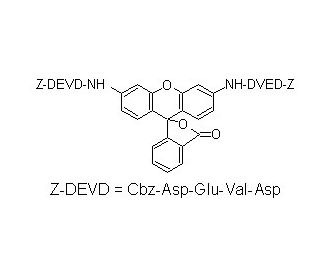


(Z-DEVD)2-R110 の分子構造
(Z-DEVD)2-R110
参考文献をチェックします (1)
アプリケーション:
(Z-DEVD)2-R110は強い蛍光を発するR110で、488 nmの励起により510-530 nmでフルオロメトリーにモニターできる。
分子量:
1515.44
試験・研究用以外には使用しないでください。 臨床及び体外診断には使用できません。
* Refer to Certificate of Analysis for lot specific data.
クイックリンク
注文情報
参考文献
説明
技術サポート情報
安全情報
SDSと分析証明書
(Z-DEVD)2-R110は、生化学および細胞生物学研究、特にカスパーゼ活性の研究のために設計された化合物である。これは、カスパーゼ活性、特にアポトーシス(プログラムされた細胞死)のプロセスにおいて重要な実行酵素であるカスパーゼ-3とカプサーゼ-7の検出と定量用に設計された蛍光性基質である。Z(ベンジルオキシカルボニル)は、最初のアスパラギン酸残基のアミノ末端をブロックするために使用される保護基で、カスパーゼ-3およびカプサーゼ-7に対する基質の特異性を高める。R110はDEVDペプチドに結合した蛍光レポーター分子である。これは緑色蛍光色素で、カスパーゼ-3とカプサーゼ-7による切断時に蛍光強度が増加する。研究において(Z-DEVD)2-R110を使用することにより、様々な実験環境においてカスパーゼ-3とカプサーゼ-7の活性を直接観察し、定量することができる。
(Z-DEVD)2-R110 参考文献
- 新規のカスパーゼ-3低分子阻害剤はアポトーシスの細胞的・生化学的特徴を阻害する。 | Scott, CW., et al. 2003. J Pharmacol Exp Ther. 304: 433-40. PMID: 12490620
- N-DEVD-N'-モルホリネカルボニル-ローダミン110:細胞ベースのアポトーシスアッセイ用の新規カスパーゼ-3蛍光性基質。 | Wang, ZQ., et al. 2005. Bioorg Med Chem Lett. 15: 2335-8. PMID: 15837320
- ヒトパピローマウイルスは上皮分化時にカスパーゼを活性化し, ウイルスゲノムの増幅を誘導する。 | Moody, CA., et al. 2007. Proc Natl Acad Sci U S A. 104: 19541-6. PMID: 18048335
- エピライシン(マトリックスメタロプロテアーゼ-28)は気道上皮細胞の生存に寄与する。 | Manicone, AM., et al. 2011. Respir Res. 12: 144. PMID: 22040290
- イソチオシアン酸ベンジルは, mTORシグナルの阻害を介して, ヒト前立腺がん細胞において保護的オートファジーを誘導する。 | Lin, JF., et al. 2013. Carcinogenesis. 34: 406-14. PMID: 23172666
- ピペロングミンはK562/A02ヒト白血病細胞においてPI3K/Aktシグナル伝達経路を介してドキソルビシン耐性を逆転させる。 | Kang, Q. and Yan, S. 2015. Exp Ther Med. 9: 1345-1350. PMID: 25780433
- オートファジー阻害は, ヒト膀胱癌細胞におけるRAD001誘発細胞毒性を増強する。 | Lin, JF., et al. 2016. Drug Des Devel Ther. 10: 1501-13. PMID: 27143856
- HER1/EGFRシグナルとRAC1シグナルの同時阻害は, in vitroでヒト神経膠腫細胞の細胞停止とSurvivinの抑制を促進する。 | Karpel-Massler, G., et al. 2017. Neurochem Res. 42: 1543-1554. PMID: 28271323
- HLBT-100:Tillandsia recurvata (L.) L.由来の高活性抗癌フラバノン。 | Lowe, HIC., et al. 2017. Cancer Cell Int. 17: 38. PMID: 28286420
- イソチオシアン酸ベンジルは, ヒト前立腺癌細胞において活性酸素種を介したオートファジーとアポトーシスを誘導する。 | Lin, JF., et al. 2017. Oncotarget. 8: 20220-20234. PMID: 28423628
- アクリジンオレンジは青色光照射下でヒト膀胱癌細胞に光損傷を与える。 | Lin, YC., et al. 2017. Sci Rep. 7: 14103. PMID: 29074848
- イソチオシアン酸アリルはヒト前立腺癌細胞においてベクリン-1のアップレギュレーションを介してオートファジーを誘導する。 | Chen, HE., et al. 2018. Am J Chin Med. 1-19. PMID: 30284468
- 卵巣がん細胞における核外輸送機構の阻害によるMDM2阻害作用の増強。 | Alzahrani, A., et al. 2022. Cancer Genet. 266-267: 57-68. PMID: 35785714
注文情報
| 製品名 | カタログ # | 単位 | 価格 | 数量 | お気に入り | |
(Z-DEVD)2-R110, 1 mg | sc-477255 | 1 mg | $104.00 |