
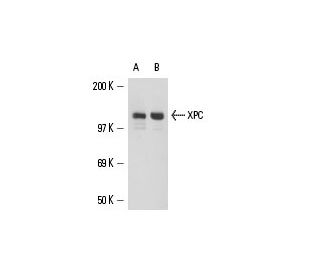
XPC Anticuerpo (A-5): sc-74411
- XPC Anticuerpo (A-5) es un monoclonal de ratón IgG1 κ, ver las 7 publicaciones, proporcionado como 200 µg/ml
- planteada frente a los aminoácidos 641-940 mapeados en el C-terminus de XPC de human origen
- recomendado para detectar XPC de human origen, mediante WB, IP, IF y ELISA
- m-IgG Fc BP-HRP es el reactivo de detección secundario preferido para XPC Anticuerpo (A-5) para aplicaciones WB. Este reactivo se ofrece ahora en un paquete con XPC Anticuerpo (A-5)(ver información de pedido más abajo).

ENLACES RÁPIDOS
VER TAMBIÉN ....
Xeroderma pigmentoso (XP) es un trastorno autosómico recesivo caracterizado por una predisposición genética al cáncer de piel inducido por la luz solar debido a deficiencias en las enzimas de reparación del ADN. Las mutaciones más frecuentes se encuentran en los genes XP del grupo A al G y del grupo V, que codifican proteínas de reparación por escisión de nucleótidos (NER). NER proporciona mecanismos versátiles de reparación del ADN para asegurar el funcionamiento adecuado de todas las células. La mayoría de los pacientes con XP tienen mutaciones en los genes XPA o XPC, que codifican proteínas involucradas en el reconocimiento del ADN dañado. El gen que codifica el XPC humano se localiza en el cromosoma 3p25. XPC forma un complejo con Cen2 y el homólogo humano de Rad23B de levadura (HR23B), ambos estabilizan XPC; también excisa dímeros de timidina del ADN dañado. Específicamente, el extremo carboxilo de XPC es necesario para la unión de HR23B y del ADN y, posteriormente, las mutaciones que resultan en truncamientos carboxi-terminales conducen a proteínas XPC no funcionales.
Alexa Fluor® es una marca registrada de Molecular Probes Inc., OR., USA
REIVEW LI-COR® y Odyssey® son marcas registradas de LI-COR Biosciences.
XPC Anticuerpo (A-5) Referencias:
- Asociación de polimorfismos del gen XPC con la susceptibilidad al cáncer de próstata: evidencia de 3936 sujetos. | Zou, YF., et al. 2013. Genet Test Mol Biomarkers. 17: 926-31. PMID: 24093803
- XPC promueve la degradación del supresor tumoral p53 mediada por MDM2. | Krzeszinski, JY., et al. 2014. Mol Biol Cell. 25: 213-21. PMID: 24258024
- La XPC inhibe la proliferación y migración de células NSCLC al aumentar la expresión de E-Cadherina. | Cui, T., et al. 2015. Oncotarget. 6: 10060-72. PMID: 25871391
- Falta de asociaciones entre los polimorfismos de XPC y el cáncer colorrectal: un metaanálisis. | Wang, G., et al. 2015. J BUON. 20: 770-4. PMID: 26214629
- La deficiencia de XPC está relacionada con la expresión y función de APE1 y OGG1. | de Melo, JT., et al. 2016. Mutat Res. 784-785: 25-33. PMID: 26811994
- Bases moleculares para el reconocimiento y verificación de daños por XPC-RAD23B y TFIIH en la reparación por escisión de nucleótidos. | Mu, H., et al. 2018. DNA Repair (Amst). 71: 33-42. PMID: 30174301
- La proteína XPC mejora el pronóstico del adenocarcinoma de pulmón al inhibir la capacidad de las células cancerosas de pulmón para generar células madre. | Wang, W., et al. 2021. Front Pharmacol. 12: 707940. PMID: 34803670
- Regulación de la dinámica de unión de XPC y la reparación global por escisión de nucleótidos por p63 y el receptor de vitamina D. | Wong, CT., et al. 2023. J Phys Chem B. 127: 2121-2127. PMID: 36877866
- Reparación por escisión de nucleótidos en líneas celulares humanas que carecen de las proteínas XPC y CSB. | Lindsey-Boltz, LA., et al. 2023. Nucleic Acids Res. 51: 6238-6245. PMID: 37144462
- Las pequeñas moléculas naturales revierten la resistencia a los medicamentos mediada por la deficiencia del grupo C de complementación del xeroderma pigmentoso (XPC) en el carcinoma de células renales. | Chen, R., et al. 2024. Phytomedicine. 124: 155310. PMID: 38215574
Información sobre pedidos
| Nombre del producto | Número de catálogo | UNIDAD | Precio | CANTIDAD | Favoritos | |
XPC Anticuerpo (A-5) | sc-74411 | 200 µg/ml | $322.00 | |||
Paquete de XPC (A-5): m-IgG Fc BP-HRP | sc-539512 | 200 µg Ab; 10 µg BP | $361.00 |