
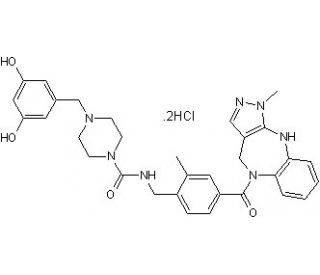

WAY 267464 dihydrochloride (CAS 1432043-31-6)
See product citations (1)
QUICK LINKS
WAY 267464 Dihydrochloride, a synthetic compound widely employed in scientific research, acts as a potent and selective agonist for the metabotropic glutamate receptor subtype 5 (mGluR5). Through its usage, researchers have explored the diverse roles of mGluR5 in numerous physiological processes, including learning and memory, mood regulation, anxiety modulation, and pain perception. The biochemical and physiological effects of WAY 267464 Dihydrochloride are multifaceted. It has demonstrated the ability to modulate neurotransmitter release, influence synaptic plasticity, and regulate cell proliferation, differentiation, and apoptosis. Acting as a potent and selective agonist, WAY 267464 Dihydrochloride binds to the metabotropic glutamate receptor subtype 5, subsequently activating the receptor and eliciting a wide array of physiological responses.
WAY 267464 dihydrochloride (CAS 1432043-31-6) References
- G9a-Mediated Regulation of OXT and AVP Expression in the Basolateral Amygdala Mediates Stress-Induced Lasting Behavioral Depression and Its Reversal by Exercise. | Kim, TK., et al. 2016. Mol Neurobiol. 53: 2843-2856. PMID: 25863961
- Biased Oxytocinergic Modulation of Midbrain Dopamine Systems. | Xiao, L., et al. 2017. Neuron. 95: 368-384.e5. PMID: 28669546
- Oxytocin and vasopressin modulation of social anxiety following adolescent intermittent ethanol exposure. | Dannenhoffer, CA., et al. 2018. Psychopharmacology (Berl). 235: 3065-3077. PMID: 30141056
- Physiological and pharmacological evaluation of oxytocin-induced milk ejection in mice. | Kamikawa, A. and Seko, J. 2020. Exp Anim. 69: 345-353. PMID: 32213759
- Social isolation modulates appetite and avoidance behavior via a common oxytocinergic circuit in larval zebrafish. | Wee, CL., et al. 2022. Nat Commun. 13: 2573. PMID: 35545618
Ordering Information
| Product Name | Catalog # | UNIT | Price | Qty | FAVORITES | |
WAY 267464 dihydrochloride, 10 mg | sc-361405 | 10 mg | $359.00 |