
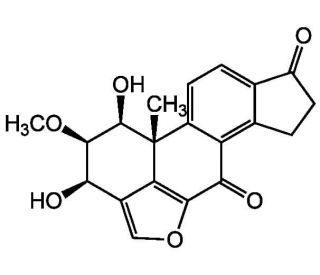

Viridiol (CAS 23820-80-6)
QUICK LINKS
Viridiol is a fungal metabolite predominantly produced by the Fusarium virguliforme species, known for its role in plant-pathogen interactions. This chemical exhibits significant phytotoxic properties, making it an essential factor in the study of plant diseases, particularly sudden death syndrome in soybeans. Viridiol acts by disrupting plant cellular processes, though the exact mechanism remains a focus of ongoing research. Preliminary studies suggest that viridiol may interfere with the plant′s cellular signaling pathways or directly affect cellular structures, leading to necrosis or apoptosis of plant tissues. This disruption is likely due to viridiol′s ability to induce oxidative stress within plant cells, a hypothesis supported by the elevated levels of reactive oxygen species observed in viridiol-exposed plant tissues. Researchers utilize viridiol to study the defense mechanisms plants employ against fungal toxins, examining gene expression changes, signaling pathway alterations, and the effectiveness of various resistance strategies plants deploy. Such studies are crucial for developing genetically resistant plant varieties or discovering novel fungicidal compounds. Beyond plant pathology, viridiol also serves as a model compound to understand more about the biosynthesis and regulation of mycotoxins in fungi, providing insights into fungal ecology and the evolutionary pressures shaping pathogen-host interactions.
Viridiol (CAS 23820-80-6) References
- Hyfraxinic Acid, a Phytotoxic Tetrasubstituted Octanoic Acid, Produced by the Ash (Fraxinus excelsior L.) Pathogen Hymenoscyphus fraxineus Together with Viridiol and Some of Its Analogues. | Masi, M., et al. 2019. J Agric Food Chem. 67: 13617-13623. PMID: 31661270
- Whole Genome Sequencing Reveals Major Deletions in the Genome of M7, a Gamma Ray-Induced Mutant of Trichoderma virens That Is Repressed in Conidiation, Secondary Metabolism, and Mycoparasitism. | Pachauri, S., et al. 2020. Front Microbiol. 11: 1030. PMID: 32595612
- Deletion of the Trichoderma virens NRPS, Tex7, induces accumulation of the anti-cancer compound heptelidic acid. | Taylor, JT., et al. 2020. Biochem Biophys Res Commun. 529: 672-677. PMID: 32736691
- Comparative analyses of the Hymenoscyphus fraxineus and Hymenoscyphus albidus genomes reveals potentially adaptive differences in secondary metabolite and transposable element repertoires. | Elfstrand, M., et al. 2021. BMC Genomics. 22: 503. PMID: 34217229
- Sampling CASE Application for the Quality Control of Published Natural Product Structures. | Moreira, LMG. and Junker, J. 2021. Molecules. 26: PMID: 34946623
- Trichoderma-Derived Pentapeptides from the Infected Nest Mycobiome of the Subterranean Termite Coptotermes testaceus. | Oberpaul, M., et al. 2022. Chembiochem. 23: e202100698. PMID: 35298064
- In Vitro Effects of Fungal Phytotoxins on Cancer Cell Viability: First Insight into Structure Activity Relationship of a Potent Metabolite of Cochliobolus australiensis Radicinin. | Mathieu, V., et al. 2022. Toxins (Basel). 14: PMID: 36006179
- Deciphering the antimicrobial activity of multifaceted rhizospheric biocontrol agents of solanaceous crops viz., Trichoderma harzianum MC2, and Trichoderma harzianum NBG. | Rahman, M., et al. 2023. Front Plant Sci. 14: 1141506. PMID: 36938007
- Specialized Metabolites Produced by Phytotopatogen Fungi to Control Weeds and Parasite Plants. | Evidente, A. 2023. Microorganisms. 11: PMID: 37110266
- Fascinating Furanosteroids and Their Pharmacological Profile. | Dembitsky, VM. 2023. Molecules. 28: PMID: 37570639
Ordering Information
| Product Name | Catalog # | UNIT | Price | Qty | FAVORITES | |
Viridiol, 250 µg | sc-391040A | 250 µg | $73.00 | |||
Viridiol, 1 mg | sc-391040 | 1 mg | $180.00 |