
Particules Lentivirales d'Activation (h) VCP: sc-401052-LAC
- Espèces cibles: human
- 200 µl de Particules Lentivirales d'Activation CRISPR/dCas9 concentrées, prêtes à la transduction
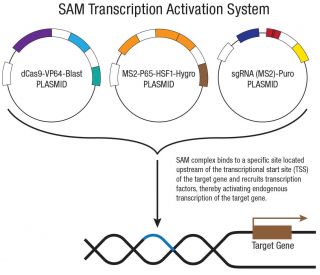
- Les Particules Lentivirales d'Activation (h) VCP correspondent à un système d'activation de la transcription par un médiateur d'activation synergique du système (SAM) spécifiquement conçu pour réguler positivement l'expression des gènes par transduction lentivirale des cellules
- Les Particules Lentivirales d'Activation (h) VCP se compose des élements d'activation SAM suivants: une nucléase Cas9 désactivée (dCas9) (D10A et N863A) fusionnées avec le domaine de transactivation VP64; une protéine de fusion MS2-p65-HSF1 et un ARN guide cible spécifique de 20nt Ils contiennent également des gènes de résistance à la blasticidine, l'hygromycine et la puromycine.
- Après transduction, le complexe SAM se fixe à une région du site spécifique d'environ 200-250 nt en amont du site de départ de la transcription du gène cible et fournit un recrutement accru des facteurs de transcription pour une activation hautement efficace du gène cible
- Les gRNA codés par le VCP Plasmide d'activation lentivirale (h) et le VCP Plasmide d'activation lentivirale (h2) ciblent des régions régulatrices distinctes du promoteur VCP. L'un ou les deux modèles peuvent être disponibles
- Après transfection, l'efficacité d'activation du gène peut être évaluée par WB, IF ou IHC en utilisant l'anticorps : VCP Antibody (D-9): sc-133212

Informations pour la commande
| Nom du produit | Ref. Catalogue | COND. | Prix HT | QTÉ | Favoris | |
Particules Lentivirales d'Activation (h) VCP | sc-401052-LAC | 200 µl | $455.00 |
La VCP humaine (valosin-containing protein ; p97) est une ATPase AAA+ qui agit comme une ségrégase centrale dans le contrôle qualité des protéines dépendant de l’ubiquitine. Elle extrait des substrats ubiquitinylés de complexes protéiques et de membranes afin de soutenir la dégradation associée au réticulum endoplasmique (ERAD), le renouvellement par le protéasome, des processus associés à la chromatine et l’autophagie, maintenant ainsi la protéostasie lors de stress cellulaires. L’activité de VCP s’articule avec le système ubiquitine–protéasome, la signalisation du stress du RE/UPR et les voies de trafic membranaire, avec des effets en aval sur l’homéostasie mitochondriale et la signalisation inflammatoire. Une fonction dérégulée de VCP a été associée à la neurodégénérescence et à des phénotypes de protéinopathie multisystémique, ce qui en fait un nœud largement utilisé pour des études mécanistiques du stress protéotoxique et des voies de clairance cellulaire.
Les particules d'activation lentivirales VCP (h) répondent à ce besoin en encapsulant le système complet d'activation transcriptionnelle SAM (Synergistic Activation Mediator) dans des particules lentivirales à titre élevé prêtes à la transduction, permettant une régulation à la hausse efficace de VCP dans un plus large éventail de types de cellules humaines.
Les particules d'activation lentivirales VCP (h) délivrent tous les composants fonctionnels du système médiateur d'activation synergique (SAM) via la transduction lentivirale. Le système comprend trois préparations de particules co-transduites dans les cellules cibles : l'une codant pour une dCas9 catalytiquement inactive (mutations D10A et N863A) fusionnée au domaine de transactivation VP64 avec un gène de résistance à la blasticidine ; une codant pour la protéine de fusion MS2-p65-HSF1 avec un gène de résistance à l'hygromycine ; et une codant pour un ARNsg de 20 nt spécifique de la cible, fusionné à deux aptamères d'ARN MS2 avec un gène de résistance à la puromycine. Après transduction lentivirale et intégration génomique des cassettes d'expression, les composants du SAM sont exprimés de manière stable et s'assemblent au locus cible dans la région promotrice proximale en amont du site de départ de la transcription VCP, où VP64, p65 et HSF1 agissent de manière coopérative pour recruter l'appareil transcriptionnel endogène et induire une régulation à la hausse soutenue de l'expression endogène de VCP. L'utilisation de dCas9 inactif sur les nucléases évite l'introduction de cassures double brin de l'ADN et préserve le locus génomique natif VCP ainsi que l'architecture régulatrice.
Le format lentiviral offre plusieurs avantages pratiques : l'intégration génomique stable permet une activation héréditaire au fil des divisions cellulaires ; les préparations de particules à titre élevé éliminent le besoin d'une production virale en interne ; et la compatibilité avec les types de cellules primaires, non divisibles et résistantes à la transfection élargit l'accessibilité expérimentale. Le succès de la transduction peut être confirmé et renforcé par une triple sélection antibiotique utilisant la puromycine, l'hygromycine et la blasticidine.
Réservé à la recherche. N'est pas destiné à un usage diagnostique ou thérapeutique.