
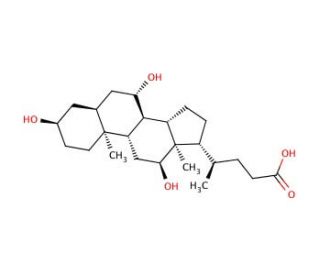

Ursocholic Acid (CAS 2955-27-3)
See product citations (4)
QUICK LINKS
Ursocholic Acid is a bile acid that is utilized in research studies to explore its role in the digestion and absorption of fats and fat-soluble vitamins in the intestines. In cellular studies, it provides insights into the regulation of cholesterol levels by investigating its impact on bile acid synthesis and cholesterol homeostasis. Due to its properties, it also serves as a tool in the investigation of membrane dynamics, as it interacts with lipid bilayers, affecting fluidity and transport processes. Researchers are interested in the signaling pathways that Ursocholic Acid may influence, particularly those related to liver function and cellular protection mechanisms. Additionally, this compound is used in analytical research to understand the composition of bile and the metabolism of bile acids, which are critical for maintaining metabolic health and understanding hepatobiliary function.
Ursocholic Acid (CAS 2955-27-3) References
- Regulation of the farnesoid X receptor (FXR) by bile acid flux in rabbits. | Xu, G., et al. 2002. J Biol Chem. 277: 50491-6. PMID: 12401785
- Hydrophilic 7 beta-hydroxy bile acids, lovastatin, and cholestyramine are ineffective in the treatment of cerebrotendinous xanthomatosis. | Batta, AK., et al. 2004. Metabolism. 53: 556-62. PMID: 15131757
- The effect of ursodeoxycholic acid therapy on the natural course of primary biliary cirrhosis. | Corpechot, C., et al. 2005. Gastroenterology. 128: 297-303. PMID: 15685541
- Efficacy and safety of ursodeoxycholic acid versus cholestyramine in intrahepatic cholestasis of pregnancy. | Kondrackiene, J., et al. 2005. Gastroenterology. 129: 894-901. PMID: 16143129
- New therapeutical indications of ursodeoxycholic acid. | Copaci, I., et al. 2005. Rom J Gastroenterol. 14: 259-66. PMID: 16200237
- High-dose ursodeoxycholic acid in primary sclerosing cholangitis: a 5-year multicenter, randomized, controlled study. | Olsson, R., et al. 2005. Gastroenterology. 129: 1464-72. PMID: 16285948
- Biochemical response to ursodeoxycholic acid and long-term prognosis in primary biliary cirrhosis. | Corpechot, C., et al. 2008. Hepatology. 48: 871-7. PMID: 18752324
- Heuman indices of hydrophobicity of bile acids and their comparison with a newly developed and conventional molecular descriptors. | Poša, M. 2014. Biochimie. 97: 28-38. PMID: 24076126
- Ursodeoxycholic acid and lithocholic acid exert anti-inflammatory actions in the colon. | Ward, JBJ., et al. 2017. Am J Physiol Gastrointest Liver Physiol. 312: G550-G558. PMID: 28360029
- Isolation of six novel 7-oxo- or urso-type secondary bile acid-producing bacteria from rat cecal contents. | Tawthep, S., et al. 2017. J Biosci Bioeng. 124: 514-522. PMID: 28751127
- Gut microbiota and metabolites associate with outcomes of immune checkpoint inhibitor-treated unresectable hepatocellular carcinoma. | Lee, PC., et al. 2022. J Immunother Cancer. 10: PMID: 35738801
- Bile acids and bile salts: ionization and solubility properties. | Carey, MC. 1984. Hepatology. 4: 66S-71S. PMID: 6479887
- Ursocholic acid, a hydrophilic bile acid, fails to improve liver function parameters in primary biliary cirrhosis: comparison with ursodeoxycholic acid. | Batta, AK., et al. 1997. Am J Gastroenterol. 92: 1035-7. PMID: 9177526
Ordering Information
| Product Name | Catalog # | UNIT | Price | Qty | FAVORITES | |
Ursocholic Acid, 10 mg | sc-473896 | 10 mg | $506.00 |