
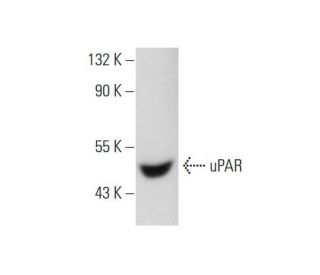


uPAR Antibody (10G7): sc-13522
- uPAR Antibody (10G7) is a mouse monoclonal IgG, cited in 16 publications, provided at 200 µg/ml
- raised against full length uPAR of human origin
- uPAR Antibody (10G7) is recommended for detection of uPAR of human origin by WB, IP, IF, IHC(P), FCM and ELISA
- Anti-uPAR Antibody (10G7) is available conjugated to agarose for IP; HRP for WB, IHC(P) and ELISA; and to either phycoerythrin or FITC for IF, IHC(P) and FCM
- also available conjugated to Alexa Fluor® 488, Alexa Fluor® 546, Alexa Fluor® 594 or Alexa Fluor® 647 for WB (RGB), IF, IHC(P) and FCM, and for use with RGB fluorescent imaging systems, such as iBright™ FL1000, FluorChem™, Typhoon, Azure and other comparable systems
- also available conjugated to Alexa Fluor® 680 or Alexa Fluor® 790 for WB (NIR), IF and FCM; for use with Near-Infrared (NIR) detection systems, such as LI-COR®Odyssey®, iBright™ FL1000, FluorChem™, Typhoon, Azure and other comparable systems
- At present, we have not yet completed the identification of the preferred secondary detection reagent(s) for uPAR Antibody (10G7). This work is in progress.

QUICK LINKS
SEE ALSO...
uPAR Antibody (10G7) is a mouse monoclonal IgG antibody that detects uPAR of human origin by western blotting (WB), immunoprecipitation (IP), immunofluorescence (IF), immunohistochemistry with paraffin-embedded sections (IHCP), flow cytometry (FCM), and enzyme-linked immunosorbent assay (ELISA). uPAR monoclonal antibody (10G7) is available in both non-conjugated and various conjugated forms, including agarose, horseradish peroxidase (HRP), phycoerythrin (PE), fluorescein isothiocyanate (FITC), and multiple Alexa Fluor® conjugates. Urokinase plasminogen activator receptor (uPAR), also known as CD87, is a glycoprotein I-anchored surface receptor that plays a critical role in the regulation of pericellular proteolysis and is essential for processes such as wound healing and tissue remodeling. Located on the cell surface, uPAR interacts with urokinase plasminogen activator (uPA) to convert plasminogen into plasmin, a serine protease that facilitates the breakdown of fibrin in blood clots. This function is particularly important in the context of tumor biology, as uPAR and uPA are often overexpressed in various cancers, promoting tumor invasion and metastasis. The signaling cascade initiated by uPA binding to uPAR involves key downstream effectors such as Ras, MEK, ERK, and MLCK, which collectively enhance cellular migration in an integrin-selective manner. Given uPAR′s significant role in cancer progression and tissue repair, uPAR serves as a valuable biomarker and therapeutic target, making uPAR monoclonal antibody (10G7) an essential tool for researchers studying these critical biological processes.
Alexa Fluor® is a trademark of Molecular Probes Inc., OR., USA
LI-COR® and Odyssey® are registered trademarks of LI-COR Biosciences
uPAR Antibody (10G7) References:
- Myosin light chain kinase functions downstream of Ras/ERK to promote migration of urokinase-type plasminogen activator-stimulated cells in an integrin-selective manner. | Nguyen, DH., et al. 1999. J Cell Biol. 146: 149-64. PMID: 10402467
- Deregulation of the signaling pathways controlling urokinase production. Its relationship with the invasive phenotype. | Aguirre Ghiso, JA., et al. 1999. Eur J Biochem. 263: 295-304. PMID: 10406935
- Identification and characterization of the murine cell surface receptor for the urokinase-type plasminogen activator. | Solberg, H., et al. 1992. Eur J Biochem. 205: 451-8. PMID: 1374026
- Cloning and expression of the receptor for human urokinase plasminogen activator, a central molecule in cell surface, plasmin dependent proteolysis. | Roldan, AL., et al. 1990. EMBO J. 9: 467-74. PMID: 1689240
- The human receptor for urokinase plasminogen activator. NH2-terminal amino acid sequence and glycosylation variants. | Behrendt, N., et al. 1990. J Biol Chem. 265: 6453-60. PMID: 2156852
- Tissue-type plasminogen activator: a new fibrinolytic agent. | Milligan, KS. 1987. Heart Lung. 16: 69-74. PMID: 3098703
- Targeting uPA-uPAR interaction to improve intestinal epithelial barrier integrity in inflammatory bowel disease. | Cheng, Y., et al. 2022. EBioMedicine. 75: 103758. PMID: 34933179
- Therapeutic strategies targeting uPAR potentiate anti-PD-1 efficacy in diffuse-type gastric cancer. | Qin, L., et al. 2022. Sci Adv. 8: eabn3774. PMID: 35613265
- The D2D3 form of uPAR acts as an immunotoxin and may cause diabetes and kidney disease. | Zhu, K., et al. 2023. Sci Transl Med. 15: eabq6492. PMID: 37729431
- Urokinase-Type Plasminogen Activator Receptor (uPAR) in Inflammation and Disease: A Unique Inflammatory Pathway Activator. | Hamada, M., et al. 2024. Biomedicines. 12: PMID: 38927374
- Factor XII signaling via uPAR-integrin β1 axis promotes tubular senescence in diabetic kidney disease. | Elwakiel, A., et al. 2024. Nat Commun. 15: 7963. PMID: 39261453
- The fibrinolytic response to ancrod therapy: characterization of fibrinogen and fibrin degradation products. | Prentice, CR., et al. 1993. Br J Haematol. 83: 276-81. PMID: 8457476
Ordering Information
| Product Name | Catalog # | UNIT | Price | Qty | FAVORITES | |
uPAR Antibody (10G7) | sc-13522 | 200 µg/ml | $322.00 | |||
uPAR Antibody (10G7) AC | sc-13522 AC | 500 µg/ml, 25% agarose | $424.00 | |||
uPAR Antibody (10G7) HRP | sc-13522 HRP | 200 µg/ml | $322.00 | |||
uPAR Antibody (10G7) FITC | sc-13522 FITC | 200 µg/ml | $336.00 | |||
uPAR Antibody (10G7) PE | sc-13522 PE | 200 µg/ml | $349.00 | |||
uPAR Antibody (10G7) Alexa Fluor® 488 | sc-13522 AF488 | 200 µg/ml | $364.00 | |||
uPAR Antibody (10G7) Alexa Fluor® 546 | sc-13522 AF546 | 200 µg/ml | $364.00 | |||
uPAR Antibody (10G7) Alexa Fluor® 594 | sc-13522 AF594 | 200 µg/ml | $364.00 | |||
uPAR Antibody (10G7) Alexa Fluor® 647 | sc-13522 AF647 | 200 µg/ml | $364.00 | |||
uPAR Antibody (10G7) Alexa Fluor® 680 | sc-13522 AF680 | 200 µg/ml | $364.00 | |||
uPAR Antibody (10G7) Alexa Fluor® 790 | sc-13522 AF790 | 200 µg/ml | $364.00 |