
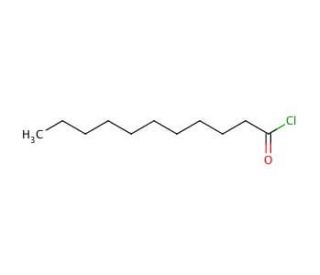

Undecanoyl chloride (CAS 17746-05-3)
QUICK LINKS
Undecanoyl chloride is an organic compound used predominantly as a reagent in chemical synthesis. This acid chloride plays a crucial role in the formation of acyl derivatives, making it a versatile intermediate in organic chemistry. With an 11-carbon fatty acyl chain and a reactive acyl chloride group, it is effective in esterification and amidation reactions, leading to the synthesis of fatty acid esters and amides for use in various research studies. In lipid chemistry, undecanoyl chloride has been instrumental in probing lipid modification mechanisms, specifically in the acylation of amines, alcohols, and other nucleophilic groups. This property makes it valuable for developing surfactants, emulsifiers, and specialized organic compounds. It serves as a building block in the synthesis of functionalized surfactants with tailored hydrophilic-lipophilic balance (HLB) values, influencing their interaction with different molecules. Furthermore, researchers leverage undecanoyl chloride′s reactivity to explore fatty acid metabolism pathways by introducing specific acyl groups into target molecules, facilitating the study of enzyme-catalyzed transformations. This compound′s hydrophobic nature and acyl chloride functionality make it an essential reagent for synthesizing new materials, probing reaction mechanisms, and expanding the understanding of lipid-based molecular interactions.
Undecanoyl chloride (CAS 17746-05-3) References
- Ceramides: branched alkyl chains in the sphingolipid siblings of diacylglycerol improve biological potency. | Kang, JH., et al. 2009. Bioorg Med Chem. 17: 1498-505. PMID: 19171486
- Design of peptide-membrane interactions to modulate single-file water transport through modified gramicidin channels. | Portella, G., et al. 2012. Biophys J. 103: 1698-705. PMID: 23083713
- Semisynthetic studies identify mitochondria poisons from botanical dietary supplements--geranyloxycoumarins from Aegle marmelos. | Li, J., et al. 2013. Bioorg Med Chem. 21: 1795-803. PMID: 23434131
- Greener pathway toward the synthesis of lichen-based ZnO@TiO2@SiO2 and Fe3O4@SiO2 nanocomposites and investigation of their biological activities. | Abdullah, SM., et al. 2020. Food Sci Nutr. 8: 4044-4054. PMID: 32884686
- Development of Novel Low-Molecular-Mass Oil-gelling Agents: Synthesis and Physical Properties of 1,5-Anhydro-D-glucitol and 1,5-Anhydro-D-mannitol Protected with Saturated Linear Fatty Acids. | Kajiki, T. and Komba, S. 2019. J Appl Glycosci (1999). 66: 103-112. PMID: 34429688
- How far is Lignin from being a biomedical material? | Sugiarto, S., et al. 2022. Bioact Mater. 8: 71-94. PMID: 34541388
- Soxhlet Extraction versus Hydrodistillation Using the Clevenger Apparatus: A Comparative Study on the Extraction of a Volatile Compound from Tamarindus indica Seeds. | Fagbemi, KO., et al. 2021. ScientificWorldJournal. 2021: 5961586. PMID: 34899085
- A Sub-Micromolar MraYAA Inhibitor with an Aminoribosyl Uridine Structure and a (S,S)-Tartaric Diamide: Synthesis, Biological Evaluation and Molecular Modeling. | Oliver, M., et al. 2022. Molecules. 27: PMID: 35335131
- Lignin-Based Materials for Additive Manufacturing: Chemistry, Processing, Structures, Properties, and Applications. | Jiang, B., et al. 2023. Adv Sci (Weinh). 10: e2206055. PMID: 36658694
- Anti-apoptotic and antioxidant mechanisms may underlie the abrogative potential of Ocimum gratissimum Linn. Leaf extract and fractions against trastuzumab-induced cardiotoxicity in Wistar rats. | Olorundare, OE., et al. 2024. Toxicol Rep. 12: 200-214. PMID: 38313815
Ordering Information
| Product Name | Catalog # | UNIT | Price | Qty | FAVORITES | |
Undecanoyl chloride, 500 mg | sc-216040 | 500 mg | $169.00 |