
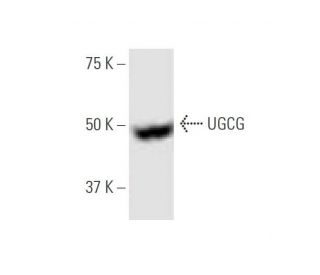


UGCG Antibody (1E5): sc-293235
- UGCG Antibody (1E5) is a mouse monoclonal IgG1 κ UGCG antibody provided at 100 µg/ml
- raised against a partial recombinant protein mapping within amino acids 33-131 of UGCG of human origin
- recommended for detection of UGCG of mouse, rat and human origin by WB, IP and ELISA
- At present, we have not yet completed the identification of the preferred secondary detection reagent(s) for UGCG Antibody (1E5). This work is in progress.

QUICK LINKS
SEE ALSO...
UGCG Antibody (1E5) is a mouse monoclonal IgG1 kappa light chain antibody that detects UGCG protein of mouse, rat, and human origin by western blotting (WB), immunoprecipitation (IP), and enzyme-linked immunosorbent assay (ELISA). Anti-UGCG antibody (1E5) is available as the non-conjugated format. UGCG protein, also known as glucosylceramide synthase, plays a crucial role in glycosphingolipid biosynthesis, catalyzing the initial glycosylation step by transferring glucose to ceramide. This enzymatic activity is vital for various cellular processes, including cell recognition, proliferation, differentiation, and immune responses. Glucosylceramide synthase is predominantly located in the plasma membrane and Golgi complex of eukaryotic cells, where enzymatic activity is essential for maintaining cellular homeostasis and signaling pathways. Dysregulation of UGCG has been linked to several pathological conditions, including lysosomal storage disorders and cancer, making UGCG a significant target for therapeutic interventions. UGCG (1E5) antibody effectively detects UGCG across multiple species, enhancing research utility in understanding molecular mechanisms underlying these diseases and potential for drug-induced apoptosis in various cell types.
Alexa Fluor® is a trademark of Molecular Probes Inc., OR., USA
LI-COR® and Odyssey® are registered trademarks of LI-COR Biosciences
UGCG Antibody (1E5) References:
- Ceramide reduction and transcriptional up-regulation of glucosylceramide synthase through doxorubicin-activated Sp1 in drug-resistant HL-60/ADR cells. | Uchida, Y., et al. 2004. Cancer Res. 64: 6271-9. PMID: 15342415
- Bifunctional role of glycosphingolipids. Modulators for transmembrane signaling and mediators for cellular interactions. | Hakomori, S. 1990. J Biol Chem. 265: 18713-6. PMID: 2229037
- The UDP-glucose ceramide glycosyltransferase (UGCG) and the link to multidrug resistance protein 1 (MDR1). | Wegner, MS., et al. 2018. BMC Cancer. 18: 153. PMID: 29409484
- UGCG influences glutamine metabolism of breast cancer cells. | Schömel, N., et al. 2019. Sci Rep. 9: 15665. PMID: 31666638
- UGCG overexpression leads to increased glycolysis and increased oxidative phosphorylation of breast cancer cells. | Schömel, N., et al. 2020. Sci Rep. 10: 8182. PMID: 32424263
- Targeting UGCG Overcomes Resistance to Lysosomal Autophagy Inhibition. | Jain, V., et al. 2023. Cancer Discov. 13: 454-473. PMID: 36331284
- UGCG modulates heart hypertrophy through B4GalT5-mediated mitochondrial oxidative stress and the ERK signaling pathway. | Cui, S., et al. 2023. Cell Mol Biol Lett. 28: 71. PMID: 37658291
- UGCG promotes chemoresistance and breast cancer progression via NF-κB and Wnt/β-catenin pathway activation. | Long, L., et al. 2025. Transl Oncol. 52: 102241. PMID: 39674092
- Purification and characterization of UDP-glucose:ceramide glucosyltransferase from rat liver Golgi membranes. | Paul, P., et al. 1996. J Biol Chem. 271: 2287-93. PMID: 8567691
- Expression cloning of a cDNA for human ceramide glucosyltransferase that catalyzes the first glycosylation step of glycosphingolipid synthesis. | Ichikawa, S., et al. 1996. Proc Natl Acad Sci U S A. 93: 4638-43. PMID: 8643456
- Up-regulation of glucosylceramide synthase expression and activity during human keratinocyte differentiation. | Watanabe, R., et al. 1998. J Biol Chem. 273: 9651-5. PMID: 9545298
- Expression of glucosylceramide synthase, converting ceramide to glucosylceramide, confers adriamycin resistance in human breast cancer cells. | Liu, YY., et al. 1999. J Biol Chem. 274: 1140-6. PMID: 9873062
Ordering Information
| Product Name | Catalog # | UNIT | Price | Qty | FAVORITES | |
UGCG Antibody (1E5) | sc-293235 | 100 µg/ml | $322.00 |