
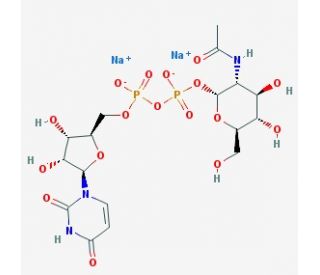

UDP-N-acetyl-D-glucosamine disodium salt (CAS 91183-98-1)
See product citations (1)
QUICK LINKS
Zinc finger BTB domain containing (ZBTB) proteins are a family of transcription factors characterized by a distinct combination of zinc finger motifs and a BTB (Broad-Complex, Tramtrack, and Bric à brac) domain. The zinc finger motifs enable DNA binding, allowing these proteins to regulate the expression of target genes, while the BTB domain facilitates protein-protein interactions, often leading to the formation of multiprotein complexes. ZBTB proteins are involved in a wide range of cellular processes, including cell cycle regulation, differentiation, and development. The diverse functions of ZBTB proteins often involve interactions with chromatin remodeling complexes, influencing epigenetic landscapes. ZBTB proteins, such as ZBTB7A (Pokemon), play a significant role in oncogenesis, highlighting their importance in cell proliferation and apoptosis. The intricate balance in ZBTB signaling is crucial for maintaining normal cellular function, and dysregulation of this balance can lead to various pathologies, including cancer and developmental disorders. Targeting Zinc finger BTB domain containing (ZBTB) proteins for disruption or inhibition is a sophisticated approach that aims to modulate the function of these transcription factors, which play pivotal roles in numerous cellular processes. Given the diversity of functions ZBTB proteins perform, from gene regulation to involvement in development and cell differentiation, their inhibition or disruption can have far-reaching cellular consequences. Strategies for targeting ZBTB proteins would likely focus on disrupting their DNA-binding capability or interfering with their interactions with other proteins, particularly within chromatin remodeling complexes.
UDP-N-acetyl-D-glucosamine disodium salt (CAS 91183-98-1) References
- Reflections on glycobiology. | Roseman, S. 2001. J Biol Chem. 276: 41527-42. PMID: 11553646
- Biosynthesis of UDP-N-acetyl-L-fucosamine, a precursor to the biosynthesis of lipopolysaccharide in Pseudomonas aeruginosa serotype O11. | Mulrooney, EF., et al. 2005. J Biol Chem. 280: 19535-42. PMID: 15778500
- Biosynthetic genes for aminoglycoside antibiotics. | Kudo, F. and Eguchi, T. 2009. J Antibiot (Tokyo). 62: 471-81. PMID: 19644520
- The second member of the bacterial UDP-N-acetyl-d-glucosamine:heparosan alpha-1, 4-N-acetyl-d-glucosaminyltransferase superfamily: GaKfiA from Gallibacterium anatis. | Wang, TT., et al. 2020. Int J Biol Macromol. 147: 170-176. PMID: 31923511
- Metabolomic adjustments in the orchid mycorrhizal fungus Tulasnella calospora during symbiosis with Serapias vomeracea. | Ghirardo, A., et al. 2020. New Phytol. 228: 1939-1952. PMID: 32668507
- N-Acetyl-D-Glucosamine Acts as Adjuvant that Re-Sensitizes Starvation-Induced Antibiotic-Tolerant Population of E. Coli to β-Lactam. | Wang, M., et al. 2020. iScience. 23: 101740. PMID: 33225246
- Synergy of the Polymyxin-Chloramphenicol Combination against New Delhi Metallo-β-Lactamase-Producing Klebsiella pneumoniae Is Predominately Driven by Chloramphenicol. | Abdul Rahim, N., et al. 2021. ACS Infect Dis. 7: 1584-1595. PMID: 33834753
- Extracellular riboflavin induces anaerobic biofilm formation in Shewanella oneidensis. | Edel, M., et al. 2021. Biotechnol Biofuels. 14: 130. PMID: 34082787
- Expression of genes involved in exopolysaccharide synthesis in Lactiplantibacillus plantarum VAL6 under environmental stresses. | Le, TS., et al. 2021. Arch Microbiol. 203: 4941-4950. PMID: 34255124
- Identification of integrative hepatotoxicity induced by lysosomal phospholipase A2 inhibition of cationic amphiphilic drugs via metabolomics. | Oh, HA., et al. 2022. Biochem Biophys Res Commun. 607: 1-8. PMID: 35358871
- Gut Steroids and Microbiota: Effect of Gonadectomy and Sex. | Diviccaro, S., et al. 2022. Biomolecules. 12: PMID: 35740892
- Dietary Isoflavones Alter Gut Microbiota and Lipopolysaccharide Biosynthesis to Reduce Inflammation. | Ghimire, S., et al. 2022. Gut Microbes. 14: 2127446. PMID: 36179318
- A Dpagt1 Missense Variant Causes Degenerative Retinopathy without Myasthenic Syndrome in Mice. | Hyde, LF., et al. 2022. Int J Mol Sci. 23: PMID: 36233305
- Synthesis of aryl azide derivatives of UDP-GlcNAc and UDP-GalNAc and their use for the affinity labeling of glycosyltransferases and the UDP-HexNAc pyrophosphorylase. | Zeng, Y., et al. 1996. Anal Biochem. 239: 99-106. PMID: 8660631
Ordering Information
| Product Name | Catalog # | UNIT | Price | Qty | FAVORITES | |
UDP-N-acetyl-D-glucosamine disodium salt, 25 mg | sc-286851 | 25 mg | $159.00 | |||
UDP-N-acetyl-D-glucosamine disodium salt, 100 mg | sc-286851A | 100 mg | $424.00 | |||
UDP-N-acetyl-D-glucosamine disodium salt, 500 mg | sc-286851B | 500 mg | $975.00 |