
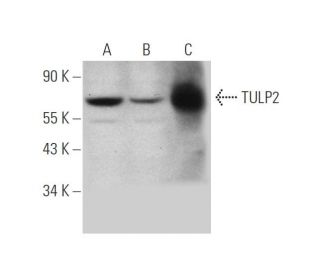
TULP2 Antibody (F-1): sc-515085
- TULP2 Antibody (F-1) is a mouse monoclonal IgG1 κ TULP2 antibody provided at 200 µg/ml
- raised against amino acids 154-320 mapping within an internal region of TULP2 of human origin
- TULP2 Antibody (F-1) is recommended for detection of TULP2 of mouse, rat and human origin by WB, IP, IF and ELISA
- Anti-TULP2 Antibody (F-1) is available conjugated to agarose for IP; HRP for WB, IHC(P) and ELISA; and to either phycoerythrin or FITC for IF, IHC(P) and FCM
- also available conjugated to Alexa Fluor® 488, Alexa Fluor® 546, Alexa Fluor® 594 or Alexa Fluor® 647 for WB (RGB), IF, IHC(P) and FCM, and for use with RGB fluorescent imaging systems, such as iBright™ FL1000, FluorChem™, Typhoon, Azure and other comparable systems
- also available conjugated to Alexa Fluor® 680 or Alexa Fluor® 790 for WB (NIR), IF and FCM; for use with Near-Infrared (NIR) detection systems, such as LI-COR®Odyssey®, iBright™ FL1000, FluorChem™, Typhoon, Azure and other comparable systems
- m-IgG1 BP-HRP is the preferred secondary detection reagent for TULP2 Antibody (F-1) for WB applications. This reagent is now offered in a bundle with TULP2 Antibody (F-1) (see ordering information below).

QUICK LINKS
TULP2 Antibody (F-1) is a mouse monoclonal IgG1 kappa light chain antibody that detects TULP2 protein of mouse, rat, and human origin by western blotting (WB), immunoprecipitation (IP), immunofluorescence (IF), and enzyme-linked immunosorbent assay (ELISA). TULP2 (F-1) antibody is available in both non-conjugated and various conjugated forms, including agarose, horseradish peroxidase (HRP), phycoerythrin (PE), fluorescein isothiocyanate (FITC), and multiple Alexa Fluor® conjugates. TULP2 plays a crucial role in regulating energy homeostasis and contributes to obesity-related disorders. TULP2 is primarily located in the inner segments of photoreceptor cells in the retina, where TULP2 is essential for proper cell functioning and vision maintenance. Mutations in the Tub gene, which encodes TULP2, lead to obesity, retinal degeneration, and neurosensory hearing loss in mice, mirroring late-onset obesity seen in humans. A human homolog of the Tub gene, along with related proteins TULP1 and TULP3, highlights evolutionary conservation and functional importance of this protein family. TULP1 shows specific expression in the retina and associates with retinitis pigmentosa, while TULP3 demonstrates broader tissue expression and shares closer phylogenetic relation to Tub than TULP1 or TULP2. TULP2′s presence in critical cellular locations underscores TULP2′s significance in both metabolic regulation and sensory function, making TULP2 a valuable target for obesity and retinal disease research.
Alexa Fluor® is a trademark of Molecular Probes Inc., OR., USA
LI-COR® and Odyssey® are registered trademarks of LI-COR Biosciences
TULP2 Antibody (F-1) References:
- Cell-specific expression of tubby gene family members (tub, Tulp1,2, and 3) in the retina. | Ikeda, S., et al. 1999. Invest Ophthalmol Vis Sci. 40: 2706-12. PMID: 10509669
- Implication of tubby proteins as transcription factors by structure-based functional analysis. | Boggon, TJ., et al. 1999. Science. 286: 2119-25. PMID: 10591637
- Cochlear and retinal degeneration in the tubby mouse. | Ohlemiller, KK., et al. 1995. Neuroreport. 6: 845-9. PMID: 7612867
- A candidate gene for the mouse mutation tubby. | Noben-Trauth, K., et al. 1996. Nature. 380: 534-8. PMID: 8606774
- Molecular characterization of TUB, TULP1, and TULP2, members of the novel tubby gene family and their possible relation to ocular diseases. | North, MA., et al. 1997. Proc Natl Acad Sci U S A. 94: 3128-33. PMID: 9096357
- Recessive mutations in the gene encoding the tubby-like protein TULP1 in patients with retinitis pigmentosa. | Hagstrom, SA., et al. 1998. Nat Genet. 18: 174-6. PMID: 9462750
- TULP1 mutation in two extended Dominican kindreds with autosomal recessive retinitis pigmentosa. | Banerjee, P., et al. 1998. Nat Genet. 18: 177-9. PMID: 9462751
- Tubby-like protein-1 mutations in autosomal recessive retinitis pigmentosa. | Gu, S., et al. 1998. Lancet. 351: 1103-4. PMID: 9660588
- Molecular characterization of a novel tubby gene family member, TULP3, in mouse and humans. | Nishina, PM., et al. 1998. Genomics. 54: 215-20. PMID: 9828123
Ordering Information
| Product Name | Catalog # | UNIT | Price | Qty | FAVORITES | |
TULP2 Antibody (F-1) | sc-515085 | 200 µg/ml | $322.00 | |||
TULP2 Antibody (F-1): m-IgG1 BP-HRP Bundle | sc-531797 | 200 µg Ab; 20 µg BP | $361.00 | |||
TULP2 Antibody (F-1) AC | sc-515085 AC | 500 µg/ml, 25% agarose | $424.00 | |||
TULP2 Antibody (F-1) HRP | sc-515085 HRP | 200 µg/ml | $322.00 | |||
TULP2 Antibody (F-1) FITC | sc-515085 FITC | 200 µg/ml | $336.00 | |||
TULP2 Antibody (F-1) PE | sc-515085 PE | 200 µg/ml | $349.00 | |||
TULP2 Antibody (F-1) Alexa Fluor® 488 | sc-515085 AF488 | 200 µg/ml | $364.00 | |||
TULP2 Antibody (F-1) Alexa Fluor® 546 | sc-515085 AF546 | 200 µg/ml | $364.00 | |||
TULP2 Antibody (F-1) Alexa Fluor® 594 | sc-515085 AF594 | 200 µg/ml | $364.00 | |||
TULP2 Antibody (F-1) Alexa Fluor® 647 | sc-515085 AF647 | 200 µg/ml | $364.00 | |||
TULP2 Antibody (F-1) Alexa Fluor® 680 | sc-515085 AF680 | 200 µg/ml | $364.00 | |||
TULP2 Antibody (F-1) Alexa Fluor® 790 | sc-515085 AF790 | 200 µg/ml | $364.00 |