
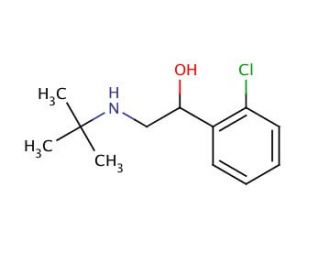

Tulobuterol (CAS 41570-61-0)
See product citations (4)
QUICK LINKS
Tulobuterol, a long-acting β2-adrenergic receptor agonist, has been extensively investigated in scientific research for its mechanism of action and potential applications in respiratory biology and drug development. Mechanistically, it selectively binds to and activates β2-adrenergic receptors located on the smooth muscle cells of the bronchial airways. Upon activation, these receptors stimulate adenylate cyclase enzyme activity, leading to increased intracellular cyclic adenosine monophosphate (cAMP) levels. Elevated cAMP levels activate protein kinase A (PKA), which phosphorylates various proteins involved in smooth muscle relaxation, including myosin light chain kinase (MLCK) and calcium channels. Consequently, Tulobuterol induces bronchodilation by relaxing bronchial smooth muscle, reducing airway resistance, and improving airflow in the lungs. In research, Tulobuterol has been studied for its efficacy in preclinical models of respiratory diseases, such as asthma and chronic obstructive pulmonary disease (COPD). Its activity has been evaluated using animal models, isolated tissue preparations, and in vitro cell culture assays, providing insights into its potential use in managing airway hyperresponsiveness and inflammation. Additionally, research has focused on elucidating the pharmacokinetic properties of Tulobuterol and optimizing its formulation to enhance pulmonary delivery and efficacy. Furthermore, studies have explored the molecular mechanisms underlying Tulobuterol′s bronchodilatory effects, offering opportunities for the development of novel β2-adrenergic receptor agonists with improved selectivity and safety profiles. Overall, Tulobuterol serves as a valuable tool in respiratory research, offering insights into bronchial smooth muscle physiology and potential targets for the treatment of airway diseases.
Tulobuterol (CAS 41570-61-0) References
- Quantitative determination of clenbuterol, salbutamol and tulobuterol enantiomers by capillary electrophoresis. | Vela, J., et al. 2001. Fresenius J Anal Chem. 369: 212-9. PMID: 11293696
- Effects of sustained-release tulobuterol on asthma control and beta-adrenoceptor function. | Kume, H., et al. 2002. Clin Exp Pharmacol Physiol. 29: 1076-83. PMID: 12390295
- High-performance liquid chromatography electrospray ionization mass spectrometry determination of tulobuterol in rabbit's plasma. | Xu, F., et al. 2005. J Pharm Biomed Anal. 37: 187-93. PMID: 15664761
- Bioequivalence of marketed transdermal delivery systems for tulobuterol. | Tojo, K. and Hikima, T. 2007. Biol Pharm Bull. 30: 1576-9. PMID: 17666825
- Characterization and release behaviors of porous PCL/Eudragit RS microcapsules containing tulobuterol. | Kim, KS. and Park, SJ. 2010. Colloids Surf B Biointerfaces. 76: 404-9. PMID: 20034769
- Effect of porous silica on sustained release behaviors of pH sensitive pluronic F127/poly(acrylic acid) hydrogels containing tulobuterol. | Kim, KS. and Park, SJ. 2010. Colloids Surf B Biointerfaces. 80: 240-6. PMID: 20621457
- Evaluation of the predicted time-concentration profile of serum tulobuterol in human after transdermal application. | Nakamura, A., et al. 2012. Chem Pharm Bull (Tokyo). 60: 300-5. PMID: 22382408
- Better adherence to a transdermal tulobuterol patch than inhaled salmeterol in elderly chronic obstructive pulmonary disease patients. | Mochizuki, H., et al. 2013. Geriatr Gerontol Int. 13: 398-404. PMID: 22817699
- Action of tulobuterol and fenoterol on the mucociliary clearance. | Matthys, H., et al. 1987. Respiration. 51: 105-12. PMID: 2884705
- Sustained release of tulobuterol from graphene oxide laden hydrogel to manage asthma. | Luo, S., et al. 2021. J Biomater Sci Polym Ed. 32: 524-535. PMID: 33175639
- Screening and Characteristics of Marine Bacillus velezensis Z-1 Protease and Its Application of Enzymatic Hydrolysis of Mussels to Prepare Antioxidant Active Substances. | Lu, J., et al. 2022. Molecules. 27: PMID: 36235106
- Quantitative determination of tulobuterol and its metabolites in human urine by mass fragmentography. | Matsumura, K., et al. 1981. J Chromatogr. 222: 53-60. PMID: 7217327
- Pharmacokinetics and pharmacodynamics of the tulobuterol patch, HN-078, in childhood asthma. | Iikura, Y., et al. 1995. Ann Allergy Asthma Immunol. 74: 147-51. PMID: 7697473
Ordering Information
| Product Name | Catalog # | UNIT | Price | Qty | FAVORITES | |
Tulobuterol, 100 mg | sc-213131 | 100 mg | $200.00 |