
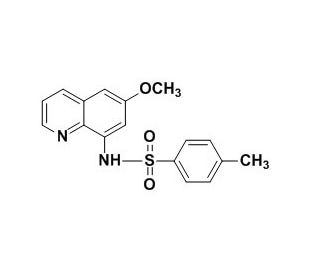

TSQ (CAS 109628-27-5)
See product citations (3)
QUICK LINKS
TSQ, represents a novel small molecule inhibitor targeting protein kinase C-α (PKC-α), an enzyme of significance. Due to its remarkable ability to inhibit PKC-α and its notable stability, TSQ has found extensive usage in diverse scientific research applications. Among its varied applications, one of the most prominent roles of TSQ lies in the study of cancer cell growth. It has demonstrated its efficacy in impeding the growth of specific cancer cell types, making it a valuable asset for researchers exploring this disease. Furthermore, TSQ has contributed to the examination of neuronal cell death, apoptosis, and certain immune responses. The mechanism underlying TSQ′s action is elegantly straightforward. By binding to the active site of the enzyme PKC-α, TSQ effectively obstructs the enzyme′s normal catalytic activity. Consequently, this inhibition of PKC-α elicits a range of cellular responses, contingent upon the cell type and the concentration of TSQ employed. This fundamental interaction paves the way for a myriad of investigative avenues within the scientific community.
TSQ (CAS 109628-27-5) References
- Endogenous Zn(2+) is required for the induction of long-term potentiation at rat hippocampal mossy fiber-CA3 synapses. | Lu, YM., et al. 2000. Synapse. 38: 187-97. PMID: 11018793
- Labile intracellular zinc is associated with 3T3 cell growth. | Paski, SC. and Xu, Z. 2001. J Nutr Biochem. 12: 655-661. PMID: 12031259
- Luminescent CdS quantum dots as selective ion probes. | Chen, Y. and Rosenzweig, Z. 2002. Anal Chem. 74: 5132-8. PMID: 12380840
- Dependence of the histofluorescently reactive zinc pool on zinc transporter-3 in the normal brain. | Lee, JY., et al. 2011. Brain Res. 1418: 12-22. PMID: 21911210
- Fluorophilia: fluorophore-containing compounds adhere non-specifically to injured neurons. | Hawkins, BE., et al. 2012. Brain Res. 1432: 28-35. PMID: 22137653
- The Genetic Landscape of β-Cell Proliferation: Toward a Road Map. | Wagner, BK. 2016. Diabetes. 65: 1789-90. PMID: 27329954
- Quantitative histofluorescence of hippocampal mossy fiber zinc. | Savage, DD., et al. 1989. Brain Res. 496: 257-67. PMID: 2804635
- Argon Enclosed Droplet Based 3D Microfluidic Device Online Coupled with Time-Resolved ICPMS for Determination of Cadmium and Zinc in Single Cells Exposed to Cadmium Ion. | Yu, X., et al. 2020. Anal Chem. 92: 13550-13557. PMID: 32883069
- Induction of Cell Death in Pancreatic Tumors by Zinc and Its Fluorescence Chelator TSQ. | Asahina, K. 2022. Biol Trace Elem Res. 200: 1667-1676. PMID: 34100198
- Role of zinc during hamster sperm capacitation. | Andrews, JC., et al. 1994. Biol Reprod. 51: 1238-47. PMID: 7888501
- Hypochlorous acid mobilizes intracellular zinc in isolated rat heart myocytes. | Tatsumi, T. and Fliss, H. 1994. J Mol Cell Cardiol. 26: 471-9. PMID: 8072005
- Characterization of N-(6-methoxy-8-quinolyl)-p-toluenesulfonamide for the detection of zinc in living sperm cells. | Andrews, JC., et al. 1995. Cytometry. 21: 153-9. PMID: 8582235
Ordering Information
| Product Name | Catalog # | UNIT | Price | Qty | FAVORITES | |
TSQ, 25 mg | sc-471927 | 25 mg | $158.00 |