
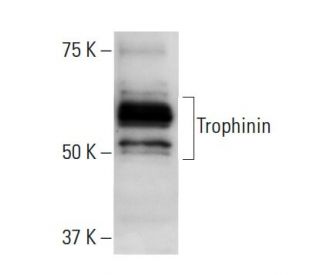

Trophinin Antibody (clone 3-11): sc-80002
- Trophinin Antibody (clone 3-11) is a mouse monoclonal IgM κ Trophinin antibody, cited in 2 publications, provided at 200 µg/ml
- raised against a synthetic peptide corresponding to amino acids 681-689 of Trophinin of human origin
- recommended for detection of Trophinin of mouse, rat and human origin by WB, IP, IF and IHC(P)
- At present, we have not yet completed the identification of the preferred secondary detection reagent(s) for Trophinin Antibody (clone 3-11). This work is in progress.

QUICK LINKS
SEE ALSO...
Trophinin Antibody (clone 3-11) is a mouse monoclonal IgM antibody that detects Trophinin protein of mouse, rat, and human origin by western blotting (WB), immunoprecipitation (IP), immunofluorescence (IF), and immunohistochemistry. Trophinin (clone 3-11) antibody is available as the non-conjugated form. Trophinin, also known as TRO or MAGED3, is a crucial apical cell adhesion molecule that plays a significant role in embryo implantation by interacting with and forming a complex with Bystin and Tastin, thereby facilitating cell adhesion. Trophinin is predominantly located in the membrane of chorionic villi trophoblasts and maternal endometrial epithelial cells, with expression being dependent on implantation. Trophinin mediates cell adhesion between trophoblastic and endometrial epithelial cells through homophilic Trophinin-Trophinin binding, which is essential for successful implantation. Notably, Trophinin expression is induced by Choriogonadotropin β and interleukin-1 beta, and higher levels of Trophinin correlate with increased cell adhesion rates. Enhancing Trophinin expression could be a strategic approach to improve implantation rates, making Trophinin a protein of interest in reproductive biology. Additionally, Trophinin is found in macrophages and contains one MAGE (melanoma-associated antigen) domain, further highlighting diverse biological roles.
Alexa Fluor® is a trademark of Molecular Probes Inc., OR., USA
LI-COR® and Odyssey® are registered trademarks of LI-COR Biosciences
Trophinin Antibody (clone 3-11) References:
- Cancer/testis antigens: structural and immunobiological properties. | Kirkin, AF., et al. 2002. Cancer Invest. 20: 222-36. PMID: 11901543
- Expression of trophinin in the cycling endometrium and its association with infertility. | Wang, HY., et al. 2002. Di Yi Jun Yi Da Xue Xue Bao. 22: 539-41. PMID: 12297480
- Trophinin is expressed in the porcine endometrium during the estrous cycle. | Nakano, S., et al. 2003. J Reprod Dev. 49: 127-34. PMID: 14967937
- Comparative expression analysis of the MAGED genes during embryogenesis and brain development. | Bertrand, M., et al. 2004. Dev Dyn. 230: 325-34. PMID: 15162511
- Apical cell adhesion molecule, trophinin, localizes to the nuclear envelope. | Aoyama, J., et al. 2005. FEBS Lett. 579: 6326-32. PMID: 16288751
- Expression of trophinin and bystin identifies distinct cell types in the germinal zones of adult rat brain. | Ma, L., et al. 2006. Eur J Neurosci. 23: 2265-76. PMID: 16706835
- Signal transduction in human embryo implantation. | Fukuda, MN. and Sugihara, K. 2007. Cell Cycle. 6: 1153-6. PMID: 17495530
- Induction of trophinin in human endometrial surface epithelia by CGbeta and IL-1beta. | Sugihara, K., et al. 2008. FEBS Lett. 582: 197-202. PMID: 18078818
Ordering Information
| Product Name | Catalog # | UNIT | Price | Qty | FAVORITES | |
Trophinin Antibody (clone 3-11) | sc-80002 | 200 µg/ml | $322.00 |