
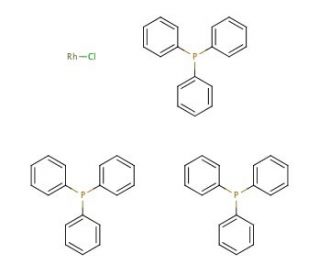

Tris(triphenylphosphine)rhodium(I) chloride 의 분자 구조, CAS 번호: 14694-95-2
Tris(triphenylphosphine)rhodium(I) chloride (CAS 14694-95-2)
대체 이름:
NSC 124140 RhCl(PPh3)3 Rhodium(I) tris(triphenylphosphine) chloride Wilkinson′s catalyst
CAS 등록번호:
14694-95-2
순도:
≥99%
분자량:
925.22
분자식:
C54H45ClP3Rh
연구용으로만 사용가능합니다. 진단이나 치료용으로 사용불가합니다.
* 참조분석증명서대량의 측정 데이터(함수량포함).
빠른 링크
주문정보
설명
기술정보
안전정보
SDS 및 분석 증명서
트리스(트리페닐포스핀)로듐(I) 클로라이드는 로듐과 트리페닐포스핀으로 이루어진 유기금속 화합물이다. 이 다재다능하고 반응성이 높은 시약은 유기 합성에 광범위하게 응용되고 있다. 지난 수십 년 동안 의학, 재료 과학, 촉매 등 다양한 분야에서 광범위하게 연구되고 사용되어 왔다. 트리스(트리페닐포스핀)로듐(I) 클로라이드는 다양한 용도로 사용되고 있다. 또한, 폴리머의 제조 및 금속 함유 나노입자의 생성에 중요한 역할을 한다. 또한, 이 화합물은 유기금속 복합체의 합성에 사용되고 유기금속 화합물의 합성을 위한 시약으로서 기능한다.
Tris(triphenylphosphine)rhodium(I) chloride (CAS 14694-95-2) 참고자료
- 베타 티로시나아제를 이용한 무담체 첨가 6-[18F]플루오로-L-도파의 효소적 합성. | Kaneko, S., et al. 1999. Appl Radiat Isot. 50: 1025-32. PMID: 10391715
- 올리고당 합성의 비닐 배당체. 2. 올리고당 합성에 알릴 및 비닐 배당체의 사용. | Boons, GJ. and Isles, S. 1996. J Org Chem. 61: 4262-4271. PMID: 11667325
- 19-nor-1α,25-디하이드록시비타민D₃에서 26-메틸기를 제거하면 시험관 내 VDR 결합, HL-60 세포 분화 및 전사에 영향을 주지 않고 생체 내 칼슘 활성도가 현저히 감소합니다. | Grzywacz, P., et al. 2010. J Med Chem. 53: 8642-9. PMID: 21105677
- 2-치환된 19-nor-1α,25-디하이드록실화된 비타민 D 화합물의 26- 및 27-메틸기는 생체 내 칼슘 이동에 필수적입니다. | Grzywacz, P., et al. 2013. Bioorg Chem. 47: 9-16. PMID: 23474215
- 다공성 형상 기억 폴리머 시스템용 세포 안정제로서 실록산 기반 양친매성 물질을 개발합니다. | Hasan, SM., et al. 2016. J Colloid Interface Sci. 478: 334-43. PMID: 27318013
- 하이드로실릴화 반응에 사용되는 로듐 및 백금 촉매의 용매로서의 이온성 액체. | Zielinski, W., et al. 2016. Molecules. 21: PMID: 27563869
- 폴로-박스 도메인 결합 펩타이드의 폴로 유사 키나아제 1 선택성 향상. | Zhao, XZ., et al. 2017. Bioorg Med Chem. 25: 5041-5049. PMID: 28285924
- 중수소 표지 아멕사녹스의 합성 및 마우스, 쥐 및 인간 마이크로솜에 대한 대사 안정성. | Gan, X., et al. 2019. J Labelled Comp Radiopharm. 62: 202-208. PMID: 30828860
- 히아신스과에서 추출한 자연 발생 및 합성 호모이소플라보노이드의 항혈관 생성 활성 (센수 APGII). | Schwikkard, S., et al. 2019. J Nat Prod. 82: 1227-1239. PMID: 30951308
- 저전압 작동 실리콘 유전체 엘라스토머에서 고투과성 필러로 사용하기 위한 포르피린의 호환성화. | Gale, CB., et al. 2020. RSC Adv. 10: 18477-18486. PMID: 35517222
- 탄소 나노튜브의 손쉬운 분산과 부드러운 피부 전극 형성을 위한 양친매성 실리콘. | Marmo, AC., et al. 2023. ACS Appl Polym Mater. 5: 775-783. PMID: 37033151
- 로듐 촉매에 의한 2-에티닐-3-펜타메틸디실라닐피리딘의 트랜스-비스-실리화 반응. | Naka, A. and Kobayashi, H. 2023. Molecules. 28: PMID: 37110518
- 디메틸안트라퀴논-올리고데옥시뉴클레오티드 접합체에 의한 DNA의 부위 특이적 및 광 유도 알킬화. | Kang, H. and Rokita, SE. 1996. Nucleic Acids Res. 24: 3896-902. PMID: 8918789
주문정보
| 제품명 | 카탈로그 번호 | 단위 | 가격 | 수량 | 관심품목 | |
Tris(triphenylphosphine)rhodium(I) chloride, 1 g | sc-253796 | 1 g | $100.00 |