
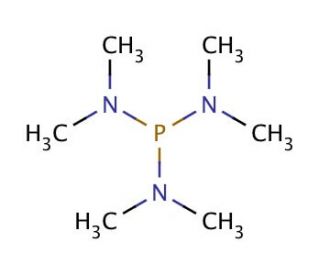

Tris(dimethylamino)phosphine (CAS 1608-26-0)
ENLACES RÁPIDOS
Tris(dimethylamino)phosphine es un compuesto organofosforado versátil ampliamente utilizado en diversas aplicaciones científicas. Es un líquido incoloro y está disponible comercialmente en dos formas: anhidro e hidratado. En el ámbito de la síntesis orgánica, tiene una importancia significativa como catalizador para la producción de una amplia gama de moléculas orgánicas. Sus aplicaciones se extienden a la química analítica, donde sirve como reactivo para detectar y cuantificar compuestos como aminoácidos, péptidos y proteínas. Además, en el campo de la bioquímica, se utiliza para medir la actividad de enzimas, como proteasas y fosfatasas. El mecanismo preciso de acción de Tris(dimethylamino)phosphine aún no se comprende completamente. Sin embargo, se cree que implica la formación de un ion fosfonio intermedio al reaccionar con una molécula de sustrato. Posteriormente, este intermedio puede ser atacado por nucleófilos, como moléculas de agua, lo que resulta en la formación de moléculas de producto.
Tris(dimethylamino)phosphine (CAS 1608-26-0) Referencias
- Preparación y caracterización de películas nanocompuestas de InP/Poli(metacrilato de metilo). | Kwon, Y. and Kim, J. 2017. J Nanosci Nanotechnol. 17: 2678-681. PMID: 29664272
- Condensación reductora mediada por fósforo(III) de α-cetoésteres y pronucleófilos próticos. | Zhao, W. and Radosevich, AT. 2015. Organic Synth. 92: 267-276. PMID: 30147197
- Precursor del telurio para la síntesis de nanocristales: Telururo de Tris(dimetilamino)fosfina. | Sun, H., et al. 2018. ACS Nano. 12: 12393-12400. PMID: 30452232
- Nuevos Protocolos Eficaces para Convertir Amidas Primarias en Nitrilos Iniciados por P(NMe2)3, PCl3, o P(OPh)3. | Talbi, I., et al. 2018. ACS Omega. 3: 5078-5082. PMID: 31458722
- Exploración química espacial de oxetanos. | Alves, FRS., et al. 2020. Int J Mol Sci. 21: PMID: 33147789
- Tris(tetrametilguanidinil)fosfina: La superbase de fósforo no iónica más sencilla y ligando de fosfina fuertemente donante. | Buß, F., et al. 2022. Chemistry. 28: e202104021. PMID: 34793627
- Aislamiento de polisulfuros de aluminio cíclicos mediante sulfuración por etapas. | Xu, H., et al. 2022. Chemistry. 28: e202104042. PMID: 34850996
- Diodos emisores de luz de puntos cuánticos verdes de alta eficacia basados en InP, regulados por el componente de la carcasa interior aleada. | Yu, P., et al. 2022. Light Sci Appl. 11: 162. PMID: 35637219
- Estrategias sintéticas para la preparación de γ-fostamas: 2-óxidos de 1,2-azafosfolidina y 2-óxidos de 1,2-azafosfolina. | Xu, J. 2022. Beilstein J Org Chem. 18: 889-915. PMID: 35957753
- Nanoplaquetas atómicamente finas de ZnTe sin metales pesados formadas a partir de nanoclusters de tamaño mágico. | Wang, F., et al. 2020. Nanoscale Adv. 2: 3316-3322. PMID: 36134285
- Un sistema biomimético de prótesis ocular: emulación autónoma de los reflejos pupilares y corneales. | Kim, S., et al. 2022. Nat Commun. 13: 6760. PMID: 36351937
- Estudio de la oxidación interfacial de puntos cuánticos de InP sintetizados a partir de tris(dimetilamino)fosfina. | Duan, X., et al. 2023. ACS Appl Mater Interfaces. 15: 1619-1628. PMID: 36574641
- Avances en los diodos emisores de luz de puntos cuánticos azules procesados en solución. | Li, SN., et al. 2023. Nanomaterials (Basel). 13: PMID: 37242111
Información sobre pedidos
| Nombre del producto | Número de catálogo | UNIDAD | Precio | CANTIDAD | Favoritos | |
Tris(dimethylamino)phosphine, 5 ml | sc-253791 | 5 ml | $66.00 |