
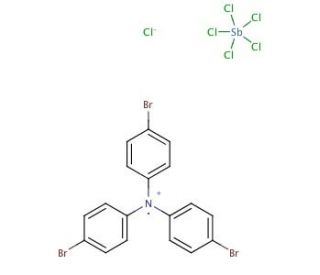

Tris(4-bromophenyl)ammoniumyl hexachloroantimonate (CAS 24964-91-8)
ENLACES RÁPIDOS
El hexacloroantimonato de tris(4-bromofenil)amonio funciona como catalizador en la síntesis orgánica, interviniendo en la formación de enlaces carbono-carbono y carbono-heteroátomo. Su mecanismo de acción consiste en facilitar el acoplamiento de sustratos orgánicos a través de una serie de reacciones químicas, dando lugar a la formación de nuevos compuestos químicos. El hexacloroantimonato de tris(4-bromofenil)amonio actúa como un ácido de Lewis, promoviendo la activación de moléculas orgánicas y permitiéndoles sufrir diversas transformaciones. Mediante su interacción con los reactivos, aumenta la eficacia del proceso al reducir la energía de activación y promover las reacciones químicas deseadas. El hexacloroantimonato de tris(4-bromofenil)amonio desempeña un papel en el desarrollo de nuevos compuestos y materiales orgánicos al permitir la construcción de estructuras moleculares complejas mediante reacciones químicas controladas. Su capacidad para catalizar reacciones específicas de formación de enlaces puede ser una función en la exploración de nuevas vías químicas y la síntesis de diversos compuestos orgánicos.
Tris(4-bromophenyl)ammoniumyl hexachloroantimonate (CAS 24964-91-8) Referencias
- Glicosilación mediante un reactivo homogéneo con transferencia de un electrón. Aplicación a una síntesis eficaz del núcleo trimanosílico de N-glicosilproteínas. | Zhang, YM., et al. 1992. Carbohydr Res. 236: 73-88. PMID: 1291063
- Estudio estructural, espectroscópico y computacional de una serie octaédrica no hemo [Fe-NO](6-8): [Fe(NO)(ciclam-ac)]2+/+/0. | Serres, RG., et al. 2004. J Am Chem Soc. 126: 5138-53. PMID: 15099097
- Caracterización y reactividad de un aducto terminal de níquel(III)-oxígeno. | Pirovano, P., et al. 2015. Chemistry. 21: 3785-90. PMID: 25612563
- Ajuste de la reactividad de los aductos terminales de níquel(III)-oxígeno para la activación del enlace C-H. | Pirovano, P., et al. 2016. J Am Chem Soc. 138: 14362-14370. PMID: 27739688
- Reacción oxidativa de tipo Povarov iniciada por hexacloroantimonato de tris(4-bromofenil)aminio entre ésteres de glicina y (ciclopropilidenmetil)bencenos utilizando el contraión como donante de cloro. | Yuan, Y., et al. 2020. Org Lett. 22: 6294-6298. PMID: 32806190
- Hidratación selectiva catalizada por radicales de catión amonio de eninos (E)-aril. | Giel, MC., et al. 2021. Chem Commun (Camb). 57: 6991-6994. PMID: 34159967
- Hexacloroantimonato de tris(4-bromofenil)aminio como iniciador de la cloración C-H promovida por activación de C-H mediante relé: Síntesis de pirroles clorados. | Ding, H., et al. 2022. J Org Chem. 87: 15139-15151. PMID: 36398528
- Síntesis, dopaje de agujeros y propiedades eléctricas de un marco orgánico covalente semiconductor basado en azatrianguleno. | Burke, DW., et al. 2023. J Am Chem Soc. 145: 11969-11977. PMID: 37216443
Información sobre pedidos
| Nombre del producto | Número de catálogo | UNIDAD | Precio | CANTIDAD | Favoritos | |
Tris(4-bromophenyl)ammoniumyl hexachloroantimonate, 1 g | sc-251397 | 1 g | $28.00 |