
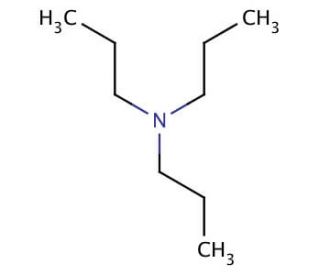

Tripropylamine の分子構造、CAS番号: 102-69-2
Tripropylamine (CAS 102-69-2)
CAS 番号:
102-69-2
純度:
≥98%
分子量:
143.27
分子式:
C9H21N
補足情報:
これは輸送上の危険物に分類され、追加の送料が発生する場合があります。
試験・研究用以外には使用しないでください。 臨床及び体外診断には使用できません。
* Refer to Certificate of Analysis for lot specific data.
クイックリンク
注文情報
説明
技術サポート情報
安全情報
SDSと分析証明書
トリプロピルアミン(TPA)は分子式C3H9Nを有する有機化合物である。一対の非共有電子を有する基本的窒素原子を特徴とする有機化合物の一種であるアミンに分類されるTPAは,強力なアンモニア様芳香を発する無色の液体である。この液体物質は水と容易に混合し、様々な実験室の状況や有機合成法において有用性を見出している。トリプロピルアミンの汎用性の高さは、科学研究分野への応用を可能にする。触媒として用いられ,試薬として有機化合物の構築を容易にし,医薬品製造を助け,酵素安定化剤として機能する。さらに、その役割は、ポリマー合成、クロマトグラフィー溶媒、および染料および顔料の処方にまで及ぶ。トリプロピルアミンはプロトン寄与因子の役割を担い、分子やイオンにプロトンを与え、それによって新しい分子やイオンを発生させる。この機構は、有機金属錯体の生成とともに、アミドやアミンの生成を含む多くの化学反応を支配する。
Tripropylamine (CAS 102-69-2) 参考文献
- AlPO4-5チャンネル内でのカーボンナノチューブ成長の第一段階としてのトリプロピルアミンの熱解離。 | Liu, JW. and Liu, ZF. 2010. J Comput Chem. 31: 1681-8. PMID: 20058229
- トリプロピルアミンで開始されるアクリジニウムエステルの電気化学発光を利用したDNAセンサー。 | He, Y., et al. 2011. Anal Bioanal Chem. 399: 3451-8. PMID: 20814666
- 標的ヌクレオチドと相補ヌクレオチドの分子内置換をプローブとするトリプロピルアミン酸化を利用した電気化学的アプタセンサー。 | Liu, DY., et al. 2011. Biosens Bioelectron. 26: 2905-10. PMID: 21183329
- Ru(bpy)3(2+)/トリプロピルアミンの安定したエレクトロケミルミネッセンスを向上させるとともに, エレクトロケミルミネッセンスに基づく高感度分析のために酸化インジウムスズの光学的透明性を維持するための, デンドリマー内包ナノ粒子による酸化インジウムスズの修飾。 | Kim, Y. and Kim, J. 2014. Anal Chem. 86: 1654-60. PMID: 24397739
- 3Dプリントスーパーキャパシターによる電気化学発光タンパク質イムノアレイ。 | Kadimisetty, K., et al. 2016. Biosens Bioelectron. 77: 188-93. PMID: 26406460
- サイクラーゼ阻害剤トリプロピルアミンは, Blakeslea trisporaのリコピン蓄積を有意に促進した。 | Wang, Y., et al. 2016. J Biosci Bioeng. 122: 570-576. PMID: 27238833
- 窒化炭素上のリガンドフリー金ナノクラスターによるアルコール, トリプロピルアミンおよびDNAの電極触媒酸化。 | Yao, H., et al. 2016. ChemElectroChem. 3: 2100-2109. PMID: 28497012
- 固体電気化学発光のためのルテニウム(II)-ポリピリジルドープジルコニウム(IV)有機金属骨格。 | Cai, M., et al. 2018. Dalton Trans. 47: 16807-16812. PMID: 30431029
- 多面体オリゴマーシルセスキオキサンを用いた耐酸素性電気化学発光システム。 | Nakamura, R., et al. 2019. Polymers (Basel). 11: PMID: 31295820
- トリプロピルアミンを用いたピロロピロールAza-BODIPYの近赤外領域における効率的な電解化学発光:S2およびT2状態の形成を伴う。 | Ishimatsu, R., et al. 2019. J Am Chem Soc. 141: 11791-11795. PMID: 31314503
- トリプロピルアミンをコアクタントに用いたCdTe量子ドットのアノード電気化学発光:サイズ依存効果. | Nakayama, M., et al. 2020. Anal Sci. 36: 859-863. PMID: 32009024
- フリースタンディング2次元Siナノシートの溶媒誘起成長. | Wang, F., et al. 2020. Small. 16: e2005426. PMID: 33205580
- 非標的グローバルメタボローム解析により, Blakeslea trisporaにおけるトリプロピルアミンによるリコピン蓄積のメカニズムが明らかになった。 | Wang, Y., et al. 2021. Front Bioeng Biotechnol. 9: 673225. PMID: 34150732
- 極性電極における単一巨大リポソーム開口部の動的電気化学発光イメージング。 | Ben Trad, F., et al. 2022. Anal Chem. 94: 1686-1696. PMID: 34995073
- Au@SiO2およびトリプロピルアミンエンドヌクレアーゼアシストサイクリングプロセスによるシグナル増幅を用いた鉛(II)イオン測定のための電気化学発光バイオセンサー。 | Zhai, H., et al. 2022. Mikrochim Acta. 189: 317. PMID: 35930068
注文情報
| 製品名 | カタログ # | 単位 | 価格 | 数量 | お気に入り | |
Tripropylamine, 25 ml | sc-237369 | 25 ml | $27.00 | |||
Tripropylamine, 500 ml | sc-237369A | 500 ml | $57.00 |