
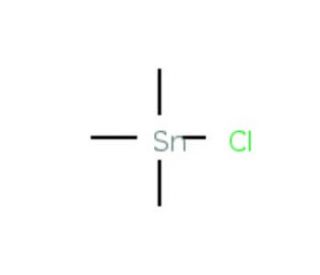

Trimethyltin chloride (CAS 1066-45-1)
QUICK LINKS
Trimethyltin chloride functions as an organotin compound in experiment. It acts as an alkylating agent, targeting nucleophilic sites on biomolecules such as proteins and nucleic acids. This interaction disrupts the normal function of these biomolecules, leading to cellular damage and ultimately cell death. Trimethyltin chloride′s mechanism of action involves the transfer of its methyl groups to nucleophilic sites, resulting in the inhibition of necessary cellular processes. Trimethyltin chloride has ability to induce neurotoxicity in experimental models, making it useful in studying the effects of organotin compounds on the nervous system. Its ability to disrupt cellular function at the molecular level makes it a useful chemical for investigating the mechanisms of toxicity and cellular damage in experiment.
Trimethyltin chloride (CAS 1066-45-1) References
- Different Activation of IL-10 in the Hippocampus and Prefrontal Cortex During Neurodegeneration Caused by Trimethyltin Chloride. | Kamaltdinova, E., et al. 2021. J Mol Neurosci. 71: 613-617. PMID: 32803646
- Mechanism in bradycardia induced by Trimethyltin chloride: Inhibition activity and expression of Na+/K+-ATPase and apoptosis in myocardia. | Liu, Z., et al. 2020. J Toxicol Sci. 45: 549-558. PMID: 32879254
- The main mechanisms of trimethyltin chloride-induced neurotoxicity: Energy metabolism disorder and peroxidation damage. | Liu, Z., et al. 2021. Toxicol Lett. 345: 67-76. PMID: 33865920
- Effect of Trimethyltin chloride on proliferation and cell cycle of intestinal porcine epithelial cells. | Fan, Y., et al. 2021. Comp Biochem Physiol C Toxicol Pharmacol. 249: 109131. PMID: 34246797
- Melatonin ameliorates trimethyltin chloride-induced cardiotoxicity: The role of nuclear xenobiotic metabolism and Keap1-Nrf2/ARE axis-mediated pyroptosis. | Cai, J., et al. 2022. Biofactors. 48: 481-497. PMID: 34570919
- TMT induces apoptosis and necroptosis in mouse kidneys through oxidative stress-induced activation of the NLRP3 inflammasome. | Liu, XJ., et al. 2022. Ecotoxicol Environ Saf. 230: 113167. PMID: 34995909
- Trans-Anethole Alleviates Trimethyltin Chloride-Induced Impairments in Long-Term Potentiation. | Chang, W., et al. 2022. Pharmaceutics. 14: PMID: 35890317
- Autophagy in Neurons of the Prefrontal Cortex and Hippocampus of Rats after Trimethyltin Chloride Intoxication. | Mikheeva, IB., et al. 2022. Bull Exp Biol Med. 173: 660-664. PMID: 36214987
- ROS/ER stress contributes to trimethyltin chloride-mediated hepatotoxicity; Tea polyphenols alleviate apoptosis and immunosuppression. | Zhu, H., et al. 2023. Comp Biochem Physiol C Toxicol Pharmacol. 263: 109505. PMID: 36370998
- Novel Push-Pull Benzodithiophene-Containing Polymers as Hole-Transport Materials for Efficient Perovskite Solar Cells. | Mikheeva, AN., et al. 2022. Molecules. 27: PMID: 36500425
- PK2/PKRs pathway is involved in the protective effect of artemisinin against trimethyltin chloride-induced hippocampal injury. | Gao, Y., et al. 2023. Toxicology. 486: 153432. PMID: 36696940
- Editorial: The mechanism of trace elements on regulating immunity in prevention and control of human and animal diseases. | Zhang, X., et al. 2023. Front Immunol. 14: 1159289. PMID: 36911709
- Postnatal exposure to trimethyltin chloride induces retinal developmental neurotoxicity in mice via glutamate and its transporter related changes. | Kim, J., et al. 2023. Reprod Toxicol. 119: 108395. PMID: 37164060
Ordering Information
| Product Name | Catalog # | UNIT | Price | Qty | FAVORITES | |
Trimethyltin chloride, 5 g | sc-301942 | 5 g | $52.00 | |||
Trimethyltin chloride, 25 g | sc-301942A | 25 g | $233.00 |