
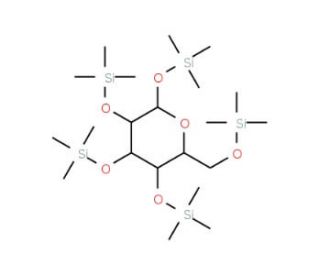

Trimethylsilyl-α-D-(+)-glucose (CAS 3327-61-5)
QUICK LINKS
Trimethylsilyl-α-D-(+)-glucose, a synthetic derivative of glucose, has found extensive utility in scientific research. Its primary role involves serving as a valuable probe in the investigation of glucose transport and metabolism within cells. Compared to other glucose analogs, Trimethylsilyl-α-D-(+)-glucose boasts several advantageous traits, notably its stability and ease of use. In various scientific experiments, Trimethylsilyl-α-D-(+)-glucose plays a central role in measuring glucose uptake or metabolism. It is frequently employed in diverse assays, including glucose uptake assays, glucose utilization assays, and glucose transport assays. The process by which Trimethylsilyl-α-D-(+)-glucose interacts with cells is as follows: it is taken up by cells through glucose transporters. Subsequently, within the cellular environment, Trimethylsilyl-α-D-(+)-glucose undergoes phosphorylation courtesy of hexokinase, transforming into TMS-alpha-D-(+)-glucose-6-phosphate. This metabolite cannot be further processed, leading to its accumulation within the cell. This accumulation of TMS-alpha-D-(+)-glucose-6-phosphate allows researchers to measure and deduce glucose uptake or metabolism levels effectively.
Ordering Information
| Product Name | Catalog # | UNIT | Price | Qty | FAVORITES | |
Trimethylsilyl-α-D-(+)-glucose, 100 mg | sc-281177 | 100 mg | $34.00 | |||
Trimethylsilyl-α-D-(+)-glucose, 500 mg | sc-281177A | 500 mg | $225.00 |