
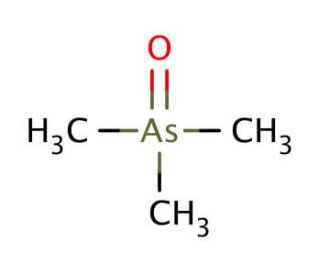

Trimethylarsinoxide (CAS 4964-14-1)
Vedere citazioni di prodotto (2)
LINK RAPIDI
L'ossido di trimetilarsina (TMAO) è stato utilizzato in diverse applicazioni scientifiche, tra cui la sintesi di altri composti organici e come composto modello per studiare l'impatto biochimico e fisiologico dell'arsenico. Inoltre, è stato utilizzato nella ricerca per esplorare la sua potenziale tossicità ambientale. L'esatto meccanismo d'azione della trimetilarsina ossido è ancora piuttosto indistinto. Tuttavia, si ritiene che sia legato alla sua capacità di interagire con le proteine contenenti tioli, portando all'interruzione dei processi cellulari. Inoltre, è stato dimostrato che la TMAO inibisce l'attività di diversi enzimi, compresi quelli del citocromo P450, che sono parte integrante del metabolismo di molti composti.
Trimethylarsinoxide (CAS 4964-14-1) Referenze
- Effetti favorevoli dell'acido monometilarsonico, dell'acido dimetilarsinico e dell'ossido di trimetilarsina sull'induzione dei foci positivi della forma placentare della glutatione S-transferasi preneoplastica del fegato di ratto: un possibile meccanismo di specie reattive dell'ossigeno. | Nishikawa, T., et al. 2002. Int J Cancer. 100: 136-9. PMID: 12115560
- Tumorigenicità epatica dell'ossido di trimetilarsina in ratti maschi Fischer 344: associazione con danni ossidativi al DNA e aumento della proliferazione cellulare. | Shen, J., et al. 2003. Carcinogenesis. 24: 1827-35. PMID: 12919961
- La dimetilarsina e la trimetilarsina sono potenti genotossine in vitro. | Andrewes, P., et al. 2003. Chem Res Toxicol. 16: 994-1003. PMID: 12924927
- Speciazione dell'acido dimetilarsinico e dell'ossido di trimetilarsina nelle urine di ratti alimentati con acido dimetilarsinico e dimercaptopropano solfonato. | Lu, X., et al. 2003. Anal Chem. 75: 6463-8. PMID: 14640715
- Il glutatione modula la formazione di metiltransferasi ricombinante di arsenico di ratto (stato di ossidazione +3) catalizzata da trimetilarsina ossido e trimetilarsina. | Waters, SB., et al. 2004. Chem Res Toxicol. 17: 1621-9. PMID: 15606138
- Tossicità e metabolismo della trimetilarsina nel topo e nel criceto. | Yamauchi, H., et al. 1990. Fundam Appl Toxicol. 14: 399-407. PMID: 2318361
- Modulazione dei geni regolati dai recettori degli idrocarburi arilici mediante somministrazione acuta di ossido di trimetilarsina nel polmone, nel rene e nel cuore di topi C57BL/6. | Elshenawy, OH. and El-Kadi, AO. 2015. Xenobiotica. 45: 930-43. PMID: 26042454
- Modulazione degli enzimi regolati dai recettori degli idrocarburi arilici da parte dell'ossido di trimetilarsina in topi C57BL/6: Studi in vivo e in vitro. | Elshenawy, OH. and El-Kadi, AO. 2015. Toxicol Lett. 238: 17-31. PMID: 26144063
- Elevato ossido di trimetilarsina e arsenico inorganico nella deposizione umida monsonica estiva dell'emisfero settentrionale. | Savage, L., et al. 2017. Environ Sci Technol. 51: 12210-12218. PMID: 28977751
- Un profilo unico di speciazione dell'arsenico in Elaphomyces spp. ('tartufi di cervo') - l'ossido di trimetilarsina e l'acido metilarsonico come composti significativi dell'arsenico. | Braeuer, S., et al. 2018. Anal Bioanal Chem. 410: 2283-2290. PMID: 29430602
- Metabolismo cellulare dell'arsenocolina. | Christakopoulos, A., et al. 1988. J Appl Toxicol. 8: 119-27. PMID: 3288685
- Ossido di trimetilarsina nel pesce gatto dell'estuario (Cnidoglanis macrocephalus) e nel merlano (Sillago bassensis) dopo somministrazione orale di arsenato di sodio e come componente naturale del pesce gatto dell'estuario. | Edmonds, JS. and Francesconi, KA. 1987. Sci Total Environ. 64: 317-23. PMID: 3602996
- Riduzione dell'ossido di trimetilarsina da parte di Candida humicola. | Pickett, AW., et al. 1981. Can J Microbiol. 27: 773-8. PMID: 7296411
Informazioni ordini
| Nome del prodotto | Codice del prodotto | UNITÀ | Prezzo | Quantità | Preferiti | |
Trimethylarsinoxide, 25 mg | sc-475468B | 25 mg | $325.00 | |||
Trimethylarsinoxide, 100 mg | sc-475468 | 100 mg | $560.00 | |||
Trimethylarsinoxide, 1 g | sc-475468A | 1 g | $3800.00 |