
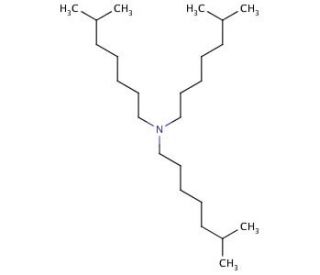

Molecular structure of Triisooctylamine, CAS Number: 25549-16-0
Triisooctylamine (CAS 25549-16-0)
CAS Number:
25549-16-0
Molecular Weight:
353.67
Molecular Formula:
C24H51N
Supplemental Information:
This is classified as a Dangerous Good for transport and may be subject to additional shipping charges.
For Research Use Only. Not Intended for Diagnostic or Therapeutic Use.
* Refer to Certificate of Analysis for lot specific data.
QUICK LINKS
Ordering Information
Description
Technical Information
Safety Information
SDS & Certificate of Analysis
Triisoctylamine is a chemical compound used as an extractant. Additionally, it serves as a reaction solution in the analytical method of amines and acidic substances. Triisoctylamine can be used in measuring the viscosity of organic solvents, including urine samples. It is also used in the extraction of uranium from sulphuric acid leaches of uranium-bearing ores.
Triisooctylamine (CAS 25549-16-0) References
- Fluorescent labeling of drugs and simple organic compounds containing amine functional groups, utilizing dansyl chloride in Na(2)CO(3) buffer. | Bartzatt, R. 2001. J Pharmacol Toxicol Methods. 45: 247-53. PMID: 11755390
- Separation study of cadmium through an emulsion liquid membrane using triisooctylamine as mobile carrier. | Li, QM., et al. 1998. Talanta. 46: 927-32. PMID: 18967215
- Method for determination of uranium isotopes in environmental samples by liquid-liquid extraction with triisooctylamine/xylene in hydrochloric media and alpha spectrometry. | Popov, L. 2012. Appl Radiat Isot. 70: 2370-6. PMID: 22871440
- Recovery of acetic acid from pre-hydrolysis liquor of hardwood kraft-based dissolving pulp production process by reactive extraction with triisooctylamine. | Yang, G., et al. 2013. Bioresour Technol. 138: 253-8. PMID: 23619137
- Use of solvent extraction for the removal of heavy metals from liquid wastes. | Cerná, M. 1995. Environ Monit Assess. 34: 151-62. PMID: 24202040
- Automatic in-syringe dispersive liquid-liquid microextraction of ⁹⁹Tc from biological samples and hospital residues prior to liquid scintillation counting. | Villar, M., et al. 2015. Anal Bioanal Chem. 407: 5571-8. PMID: 26007698
- Synthesis, crystal structure, and characterization of cyclohexylammonium tetraisothiocyanatocobaltate(II): A single-source precursor for cobalt sulfide and oxide nanostructures. | Bagabas, AA., et al. 2019. Heliyon. 5: e01139. PMID: 30723823
- Determination of plutonium isotopes in environmental samples by extraction chromatography with triisooctylamine - polyethylene resin. | Popov, L. 2019. Appl Radiat Isot. 146: 48-56. PMID: 30753984
- Effect of the Addition of Amine in Organophosphorus Compounds on Molecular Structuration of Ionic Liquids-Application to Solvent Extraction. | Gmar, S., et al. 2020. Molecules. 25: PMID: 32498438
- Lithium Harvesting from the Most Abundant Primary and Secondary Sources: A Comparative Study on Conventional and Membrane Technologies. | Butt, FS., et al. 2022. Membranes (Basel). 12: PMID: 35448344
- From Ionic Nanoparticle Organic Hybrids to Ionic Nanocomposites: Structure, Dynamics, and Properties: A Review. | Karatrantos, AV., et al. 2022. Nanomaterials (Basel). 13: PMID: 36615912
- Determination of selenium in the environment and in biological material. | Bem, EM. 1981. Environ Health Perspect. 37: 183-200. PMID: 7007035
- 'Organic phase buffers' control biocatalyst activity independent of initial aqueous pH. | Blackwood, AD., et al. 1994. Biochim Biophys Acta. 1206: 161-5. PMID: 8003520
Ordering Information
| Product Name | Catalog # | UNIT | Price | Qty | FAVORITES | |
Triisooctylamine, 100 g | sc-237326 | 100 g | $102.00 |