
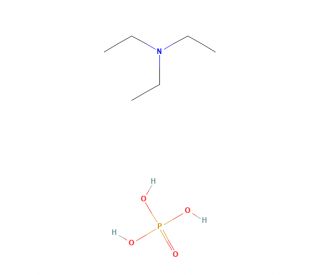

Triethylamine Phosphate (CAS 35365-94-7)
ENLACES RÁPIDOS
Triethylamine Phosphate es un compuesto que tiene importancia en la síntesis y análisis de nucleótidos, ácidos nucleicos y en el campo más amplio de la investigación en biología molecular. A menudo sirve como agente tampón durante la síntesis de ADN y ARN, donde mantener el pH adecuado es crucial para la actividad y estabilidad de las enzimas. Su capacidad tamponante también lo hace una opción ideal para aplicaciones de cromatografía líquida de alto rendimiento (HPLC, por sus siglas en inglés) en la separación y purificación de biomoléculas. Además, los investigadores utilizan trietilamina fosfato en la preparación de muestras para espectrometría de masas, ya que puede mejorar la eficiencia de ionización de ciertos compuestos. La utilidad del compuesto se extiende al estudio de membranas fosfolípidos, donde se puede utilizar para investigar el papel de los grupos fosfato en la dinámica y estructura de la membrana.
Triethylamine Phosphate (CAS 35365-94-7) Referencias
- Formación de aminas heterocíclicas mutagénicas/carcinogénicas en sistemas modelo calentados en seco, carnes y goteos de carne. | Pais, P., et al. 1999. J Agric Food Chem. 47: 1098-108. PMID: 10552422
- Determinación simultánea de fexofenadina y sus compuestos relacionados mediante HPLC. | Radhakrishna, T. and Om Reddy, G. 2002. J Pharm Biomed Anal. 29: 681-90. PMID: 12093497
- Determinación del contenido de aminas aromáticas heterocíclicas (AHs) en muestras de platos de carne preparados en el hogar. | Warzecha, L., et al. 2004. J Chromatogr B Analyt Technol Biomed Life Sci. 802: 95-106. PMID: 15036001
- Microextracción en fase sólida acoplada a cromatografía líquida de alta resolución para el análisis de aminas aromáticas heterocíclicas. | Cárdenes, L., et al. 2004. J Chromatogr A. 1030: 87-93. PMID: 15043257
- Desarrollo de un agente PET/SPECT para la obtención de imágenes amiloides en la enfermedad de Alzheimer. | Wang, Y., et al. 2004. J Mol Neurosci. 24: 55-62. PMID: 15314250
- Cromatografía de interacción hidrofílica por repulsión electrostática para la separación isocrática de solutos cargados y el aislamiento selectivo de fosfopéptidos. | Alpert, AJ. 2008. Anal Chem. 80: 62-76. PMID: 18027909
- Enriquecimiento de proteínas modificadas con O-GlcNAc mediante el método de captura con resina de oxidación de periodato-hidrazida. | Klement, E., et al. 2010. J Proteome Res. 9: 2200-6. PMID: 20146544
- Efecto inhibidor de los marinados con extracto de hibisco sobre la formación de aminas aromáticas heterocíclicas y la calidad sensorial de las hamburguesas de ternera fritas. | Gibis, M. and Weiss, J. 2010. Meat Sci. 85: 735-42. PMID: 20418021
- Distribución de la inmunorreactividad de la colecistoquinina en el sistema nervioso central de la rata mediante radioinmunoanálisis. | Beinfeld, MC., et al. 1981. Brain Res. 212: 51-7. PMID: 7225864
- Características de unión al receptor AT4: Péptidos sustituidos por D-aminoácidos y glicina. | Sardinia, MF., et al. 1993. Peptides. 14: 949-54. PMID: 8284271
- El fragmento de globina LVV-hemorfina-7 es un ligando endógeno para el receptor AT4 en el cerebro. | Moeller, I., et al. 1997. J Neurochem. 68: 2530-7. PMID: 9166749
- Método de cromatografía líquida hilada para la determinación de residuos de colistina en tejidos bovinos. | Decolin, D., et al. 1997. J Chromatogr Sci. 35: 557-64. PMID: 9397540
- Cromatografía líquida de alta resolución de par iónico en fase inversa de nucleótidos de adenina y nucleósidos utilizando trietilamina como contraión. | Uesugi, T., et al. 1997. J Chromatogr B Biomed Sci Appl. 703: 63-74. PMID: 9448063
Información sobre pedidos
| Nombre del producto | Número de catálogo | UNIDAD | Precio | CANTIDAD | Favoritos | |
Triethylamine Phosphate, 25 g | sc-475231 | 25 g | $304.00 |