
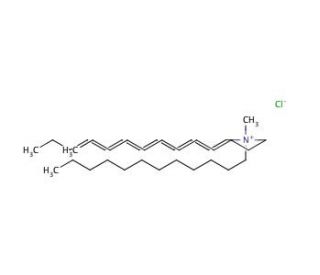

Estructura molecular de Tridodecylmethylammonium chloride, Número CAS: 7173-54-8
Tridodecylmethylammonium chloride (CAS 7173-54-8)
Nombres Alternativos:
Methyltridodecylammonium chloride
Número de CAS:
7173-54-8
Pureza:
≥95%
Peso Molecular:
572.47
Fórmula Molecular:
C37H78ClN
Para Uso Exclusivo en Investigación. No está diseñado para uso en diagnosis o terapia.
* En el Certificado de Análisis específico de lote, puede encontrar información específica (como el contenido en agua).
ENLACES RÁPIDOS
Información sobre pedidos
Descripción
Información Técnica
Información de Seguridad
SDS & Certificado de Análisis
Tridodecylmethylammonium chloride (TDMAC) es una sal de amonio cuaternario crucial ampliamente utilizada en diversos campos científicos e industriales. Sirve como un surfactante catiónico producido por la reacción entre tridodecilmetilamina y ácido clorhídrico. TDMAC funciona reduciendo la tensión superficial del agua, actuando como un surfactante. También actúa como emulsionante, facilitando la creación de emulsiones estables. Debido a sus propiedades catiónicas, puede unirse eficazmente con sustancias aniónicas como las proteínas, formando complejos estables. Además, TDMAC exhibe propiedades antifúngicas al interrumpir la membrana celular de los hongos.
Tridodecylmethylammonium chloride (CAS 7173-54-8) Referencias
- Electrodos de membrana líquida/polimérica sensibles al cloruro basados en 'éter anticorona' de mercuracarboro. | Badr, IH., et al. 1999. Anal Chem. 71: 1371-7. PMID: 10204038
- Potenciometría de electrodo rotatorio: reducción de los límites de detección de los electrodos de membrana sensibles a los poliones en desequilibrio. | Ye, Q. and Meyerhoff, ME. 2001. Anal Chem. 73: 332-6. PMID: 11199986
- Influencia del CO(2) en ISFETs con membranas poliméricas y caracterización de un sensor de iones carbonato. | Abramova, N., et al. 2010. Talanta. 81: 1750-4. PMID: 20441968
- Porfirinas de platino como ionóforos en electrodos de membrana polimérica. | Lvova, L., et al. 2011. Analyst. 136: 4966-76. PMID: 21971176
- Detección óptica directa de dióxido de carbono basada en una película polimérica dopada con un ionóforo selectivo de tipo pinza molecular. | Xie, X., et al. 2012. Anal Chem. 84: 3163-9. PMID: 22369632
- Generador de osmio-191/iridio-191m a base de gel de sílice impregnado de cloruro de tridodecilmetilamonio. | Issachar, D., et al. 1989. J Nucl Med. 30: 538-41. PMID: 2544695
- Sensores potenciométricos de membrana de PVC basados en ionóforos para la determinación de fenobarbitona en formulaciones farmacéuticas. | Alrabiah, H., et al. 2016. Acta Pharm. 66: 503-514. PMID: 27749249
- Caracterización y cuantificación de policuaternios mediante electrodos sensibles a poliones basados en membranas poliméricas de un solo uso. | Ferguson, SA. and Meyerhoff, ME. 2017. ACS Sens. 2: 268-273. PMID: 28723131
- Reducción de la adherencia bacteriana a la superficie del catéter con heparina. | Ruggieri, MR., et al. 1987. J Urol. 138: 423-6. PMID: 3298698
- Un sensor optodo colorimétrico basado en papel para la determinación altamente sensible y selectiva de tiocianato en muestra de orina utilizando un derivado de porfirina de cobalto. | Wirojsaengthong, S., et al. 2021. Talanta. 231: 122371. PMID: 33965036
- Unión de antibióticos al politetrafluoroetileno con cloruro de tridodecilmetilamonio. | Harvey, RA., et al. 1982. Surgery. 92: 504-12. PMID: 7112401
- Un nuevo sensor electroquímico de heparina. | Yang, VC., et al. 1993. ASAIO J. 39: M195-201. PMID: 8268527
- Sensor electroquímico de heparina: caracterización y aplicaciones bioanalíticas. | Ma, SC., et al. 1993. Anal Chem. 65: 2078-84. PMID: 8372971
- Sensor de heparina de alambre recubierto desechable. | Yun, JH., et al. 1994. ASAIO J. 40: M401-5. PMID: 8555546
- Aplicación clínica de los sensores de heparina desechables. Mediciones de heparina en sangre durante cirugía a corazón abierto. | Yun, JH., et al. 1995. ASAIO J. 41: M661-4. PMID: 8573887
Información sobre pedidos
| Nombre del producto | Número de catálogo | UNIDAD | Precio | CANTIDAD | Favoritos | |
Tridodecylmethylammonium chloride, 1 g | sc-255693 | 1 g | $173.00 | |||
Tridodecylmethylammonium chloride, 5 g | sc-255693A | 5 g | $720.00 |