
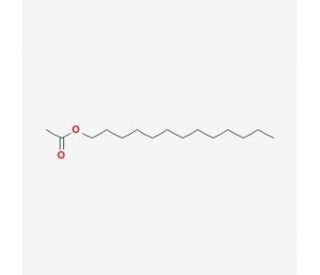

Tridecyl acetate (CAS 1072-33-9)
QUICK LINKS
Tridecyl acetate, identified by the CAS number 1072-33-9, is a chemical ester derived from tridecanol and acetic acid, known for its role in synthetic and industrial chemistry rather than biomedical contexts. This compound is primarily recognized for its applications in the formulation of fragrances and flavorings due to its distinct, mildly floral and waxy odor, which makes it valuable in the cosmetics and food industry as a scent and flavor agent. Beyond its olfactory properties, tridecyl acetate serves as a solvent and an intermediate in the production of other chemical substances. In research, particularly in studies concerning chemical ecology, tridecyl acetate has been investigated for its role as a semiochemical. The subtle emissions of this ester can be instrumental in understanding insect behavior, particularly in how certain species use chemical signals for communication. This aspect of tridecyl acetate′s function is critical in ecological studies where understanding the interaction between species through chemical mediation can provide insights into ecological balances and disruptions. Furthermore, its role in synthetic pathways is leveraged in developing advanced materials and coatings, where its properties contribute to modifying surface characteristics like hydrophobicity or adhesion in industrial applications.
Tridecyl acetate (CAS 1072-33-9) References
- Olfactory receptor responses to sex pheromone components in the redbanded leafroller moth. | O'Connell, RJ. 1975. J Gen Physiol. 65: 179-205. PMID: 1117280
- Olfactory perception of oviposition-deterring fatty acids and their methyl esters by the Asian corn borer, Ostrinia furnacalis. | Guo, L. and Qing Li, G. 2009. J Insect Sci. 9: 1-9. PMID: 20053122
- Subchronic toxicity evaluation of tridecyl acetate in rats. | Daughtrey, WC., et al. 1990. Fundam Appl Toxicol. 14: 104-12. PMID: 2307309
- The approach to sample acquisition and its impact on the derived human fecal microbiome and VOC metabolome. | Couch, RD., et al. 2013. PLoS One. 8: e81163. PMID: 24260553
- Diversity of compounds in femoral secretions of Galápagos iguanas (genera: Amblyrhynchus and Conolophus), and their potential role in sexual communication in lek-mating marine iguanas (Amblyrhynchus cristatus). | Ibáñez, A., et al. 2017. PeerJ. 5: e3689. PMID: 28828277
- Pheromone gland transcriptome of the pink bollworm moth, Pectinophora gossypiella: Comparison between a laboratory and field population. | Dou, X., et al. 2019. PLoS One. 14: e0220187. PMID: 31329654
- Geographic contrasts between pre- and postzygotic barriers are consistent with reinforcement in Heliconius butterflies. | Rosser, N., et al. 2019. Evolution. 73: 1821-1838. PMID: 31334832
- Behavioral differences among domestic cats in the response to cat-attracting plants and their volatile compounds reveal a potential distinct mechanism of action for actinidine. | Bol, S., et al. 2022. BMC Biol. 20: 192. PMID: 36008824
- Bioassay-Guided Isolation of Anthelmintic Components from Semen pharbitidis, and the Mechanism of Action of Pharbitin. | Liu, M., et al. 2022. Int J Mol Sci. 23: PMID: 36555386
Ordering Information
| Product Name | Catalog # | UNIT | Price | Qty | FAVORITES | |
Tridecyl acetate, 25 mg | sc-281175 | 25 mg | $31.00 |