
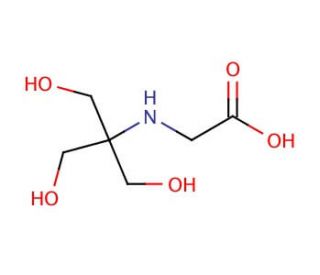

Tricine (CAS 5704-04-1)
See product citations (4)
QUICK LINKS
Tricine, or N-[tris(hydroxymethyl)methyl]glycine, is a specialized biochemical buffer known for its effective buffering capacity in the slightly alkaline range, particularly between pH 7.4 and 8.8. Developed by Ulrich Good in 1977, tricine is one of the Good′s buffers, designed to have minimal molecular interference with biological processes, making it ideal for various research applications. Tricine functions primarily as a buffering agent due to its ability to stabilize pH by absorbing or donating protons, thanks to its tertiary amine and carboxylic acid groups. This makes it particularly valuable in maintaining the pH of biochemical solutions where slight pH changes can drastically affect enzyme activity and protein stability. Tricine is extensively used in electrophoresis, especially in the separation of smaller proteins and peptides in polyacrylamide gels, where it serves as a trailing ion that does not react with the resolving species, thus ensuring clear resolution. Its low ionic mobility is advantageous in applications requiring a sharp resolution of biomolecules according to their size. Additionally, tricine has been employed in the preparation of samples for mass spectrometry and as a buffer in nucleic acid extraction procedures, where its gentle buffering capacity helps protect the integrity of delicate molecules. Its unique properties make tricine a staple in molecular biology laboratories, particularly those focusing on protein and peptide analysis.
Tricine (CAS 5704-04-1) References
- A (99m) Tc-tricine-HYNIC-labeled peptide targeting the neurotensin receptor for single-photon imaging in malignant tumors. | Erfani, M., et al. 2014. J Labelled Comp Radiopharm. 57: 125-31. PMID: 24395489
- Tricine-sodium dodecyl sulfate-polyacrylamide gel electrophoresis for the separation of proteins in the range from 1 to 100 kDa. | Schägger, H. and von Jagow, G. 1987. Anal Biochem. 166: 368-79. PMID: 2449095
- Evaluation of tricine and EDDA as Co-ligands for 99mTc-labeled HYNIC-MSH analogs for melanoma imaging. | Garcia, MF., et al. 2015. Anticancer Agents Med Chem. 15: 122-30. PMID: 25175799
- A 99mTc-tricine-HYNIC-labeled Peptide Targeting the Melanocortin-1 Receptor for Melanoma Imaging. | Shamshirian, D., et al. 2016. Iran J Pharm Res. 15: 349-360. PMID: 27980570
- Biological Evaluation of 99mTc-HYNIC-EDDA/tricine-(Ser)-D4 Peptide for Tumor Targeting. | Kazemi, Z., et al. 2017. Curr Radiopharm. 10: 123-130. PMID: 28530534
- Tricine as a convenient scaffold for the synthesis of C-terminally branched collagen-model peptides. | Stawikowski, MJ. and Fields, GB. 2018. Tetrahedron Lett. 59: 130-134. PMID: 29545652
- Tricine co-ligand improved the efficacy of 99mTc-HYNIC-(Ser)3-J18 peptide for targeting and imaging of non-small-cell lung cancer. | Shaghaghi, Z., et al. 2018. Biomed Pharmacother. 104: 325-331. PMID: 29775901
- Buffer effects on ATP analysis by firefly luciferase. | Webster, JJ., et al. 1980. Anal Biochem. 106: 7-11. PMID: 7191217
- Characterization of phorbol ester-stimulated serine phosphorylation of the human insulin receptor. | Feener, EP., et al. 1994. Biochem J. 303 (Pt 1): 43-50. PMID: 7945263
Ordering Information
| Product Name | Catalog # | UNIT | Price | Qty | FAVORITES | |
Tricine, 100 g | sc-216103 | 100 g | $33.00 | |||
Tricine, 250 g | sc-216103A | 250 g | $75.00 |