
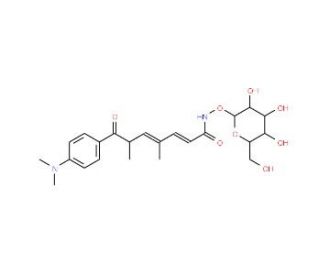

Trichostatin C (CAS 68676-88-0)
See product citations (2)
QUICK LINKS
Trichostatin C, bearing the CAS number 68676-88-0, is a naturally occurring hydroxamic acid that belongs to the broader class of compounds known as histone deacetylase inhibitors (HDAC inhibitors). This chemical is derived from Streptomyces hygroscopicus and is structurally characterized by its unique cyclic peptide backbone coupled with a hydroxamic acid moiety. The primary mechanism of action of Trichostatin C involves the inhibition of histone deacetylase enzymes, which play a critical role in the regulation of gene expression by modifying the acetylation status of histone proteins. When Trichostatin C inhibits these enzymes, it leads to an increase in the acetylation levels of histones, promoting a more open chromatin structure that facilitates transcriptional activation. In research settings, Trichostatin C has been extensively used as a tool to study chromatin remodeling and gene expression regulation. It helps explain the molecular mechanisms controlling gene activity, particularly in the context of epigenetic modifications that influence cellular differentiation, development, and response to environmental stimuli. By altering histone acetylation, researchers can explore how gene expression patterns are affected in various biological processes and disease states, providing insights into the complex regulation of cellular functions at the molecular level.
Trichostatin C (CAS 68676-88-0) References
- Isoform-selective histone deacetylase inhibitors. | Bieliauskas, AV. and Pflum, MK. 2008. Chem Soc Rev. 37: 1402-13. PMID: 18568166
- Using histone deacetylase inhibitors to enhance Foxp3(+) regulatory T-cell function and induce allograft tolerance. | Wang, L., et al. 2009. Immunol Cell Biol. 87: 195-202. PMID: 19172156
- Modulation of growth and differentiation of human colon carcinoma cells by histone deacetylase inhibitory trichostatins. | Li, X., et al. 1996. Int J Oncol. 8: 431-7. PMID: 21544379
- Effects of trichostatins on differentiation of murine erythroleukemia cells. | Yoshida, M., et al. 1987. Cancer Res. 47: 3688-91. PMID: 2439196
- Reversible arrest of proliferation of rat 3Y1 fibroblasts in both the G1 and G2 phases by trichostatin A. | Yoshida, M. and Beppu, T. 1988. Exp Cell Res. 177: 122-31. PMID: 3134246
- Screening for tyrosinase inhibitors from actinomycetes; identification of trichostatin derivatives from Streptomyces sp. CA-129531 and scale up production in bioreactor. | Georgousaki, K., et al. 2020. Bioorg Med Chem Lett. 30: 126952. PMID: 32005414
- Trichostatin C Synergistically Interacts with DNMT Inhibitor to Induce Antineoplastic Effect via Inhibition of Axl in Bladder and Lung Cancer Cells. | Wang, C., et al. 2024. Pharmaceuticals (Basel). 17: PMID: 38675387
- Trichostatin C, a glucopyranosyl hydroxamate. | Tsuji, N. and Kobayashi, M. 1978. J Antibiot (Tokyo). 31: 939-44. PMID: 711616
- Promotion of antigen-specific antibody production in murine B cells by a moderate increase in histone acetylation. | Kohge, T., et al. 1998. Biochem Pharmacol. 56: 1359-64. PMID: 9825735
- Trichostatin C, a new inducer of differentiation of Friend leukemic cells | Yoshida, M., et al. 1985. Agricultural and biological chemistry. 49(2): 563-565.
Ordering Information
| Product Name | Catalog # | UNIT | Price | Qty | FAVORITES | |
Trichostatin C, 500 µg | sc-202369 | 500 µg | $359.00 |