
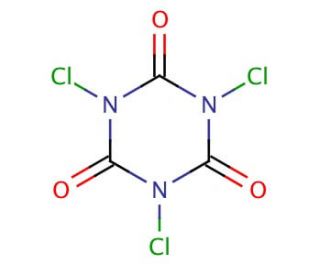

Trichloroisocyanuric acid (CAS 87-90-1)
QUICK LINKS
Trichloroisocyanuric acid functions as a disinfectant and biocide in experimental applications. Its mechanism of action involves releasing hypochlorous acid, which is a potent oxidizing agent. This leads to the disruption of the cell walls of microorganisms, causing damage to their cellular components and ultimately leading to their inactivation. At the molecular level, trichloroisocyanuric acid reacts with water to release hypochlorous acid, which then interacts with the proteins and enzymes within the microorganism, disrupting their structure and function. Trichloroisocyanuric Acid′s function as a disinfectant may be useful for experimental purposes where the control of microbial contamination is necessary. Its mechanism of action at the cellular and molecular level allows for the study of microbial inactivation and the development of effective disinfection strategies.
Trichloroisocyanuric acid (CAS 87-90-1) References
- Response of the freshwater Alga chlorella vulgaris to trichloroisocyanuric acid and ciprofloxacin. | Nie, X., et al. 2008. Environ Toxicol Chem. 27: 168-73. PMID: 18092852
- Trichloroisocyanuric acid (TCCA): an efficient green reagent for activation of thioglycosides toward hydrolysis. | Basu, N., et al. 2013. Carbohydr Res. 369: 10-3. PMID: 23370167
- Trichloroisocyanuric Acid Promoted Cascade Cyclization/Trifluoromethylation of Allylic Oximes: Synthesis of Trifluoromethylated Isoxazolines. | Zhang, W., et al. 2017. Org Lett. 19: 376-379. PMID: 28067052
- Mild Aliphatic and Benzylic Hydrocarbon C-H Bond Chlorination Using Trichloroisocyanuric Acid. | Combe, SH., et al. 2017. J Org Chem. 82: 2407-2413. PMID: 28106993
- Amplification of Trichloroisocyanuric Acid (TCCA) Reactivity for Chlorination of Arenes and Heteroarenes via Catalytic Organic Dye Activation. | Rogers, DA., et al. 2019. Org Lett. 21: 4229-4233. PMID: 31140821
- Difluoro(aryl)(perfluoroalkyl)-λ4 -sulfanes and Selanes: Missing Links of Trichloroisocyanuric Acid/Potassium Fluoride Chemistry. | Brüning, F., et al. 2019. Angew Chem Int Ed Engl. 58: 18937-18941. PMID: 31596543
- Transcriptome Analysis Provides Insights into Hepatic Responses to Trichloroisocyanuric Acid Exposure in Goldfish (Carassius auratus). | Zhou, S., et al. 2021. Animals (Basel). 11: PMID: 34679797
- Preparation and disinfection properties of graphene oxide/trichloroisocyanuric acid disinfectant. | Jiang, L., et al. 2021. Nanotechnology. 33: PMID: 34798630
- [The influence of melanin bleaching by trichloroisocyanuric acid on the immunohistochemistry staining]. | Wu, HY., et al. 2021. Zhonghua Bing Li Xue Za Zhi. 50: 1372-1375. PMID: 34865428
- Oxidative Fluorination of Heteroatoms Enabled by Trichloroisocyanuric Acid and Potassium Fluoride. | Kraemer, Y., et al. 2022. Angew Chem Int Ed Engl. 61: e202205088. PMID: 35580251
- The Drinking Water and Swimming Pool Disinfectant Trichloroisocyanuric Acid Causes Chlorination Stress Enhancing Solar UV-Induced Inflammatory Gene Expression in AP-1 Transgenic SKH-1 Luciferase Reporter Mouse Skin. | Snell, JA., et al. 2023. Photochem Photobiol. 99: 835-843. PMID: 35841216
- Trichloroisocyanuric Acid, A Swimming Pool Disinfectant: New Developments and Role in UV-Induced Skin Inflammation†. | Chhabra, G. and Ahmad, N. 2023. Photochem Photobiol. 99: 869-871. PMID: 36004539
- Construction of hematoxylin-eosin, immunohistochemistry, and EBER-ISH methodology after trichloroisocyanuric acid treatment in melanin-containing tissues. | Wang, C., et al. 2022. Sci Rep. 12: 16062. PMID: 36163422
Ordering Information
| Product Name | Catalog # | UNIT | Price | Qty | FAVORITES | |
Trichloroisocyanuric acid, 100 g | sc-251311 | 100 g | $38.00 |