
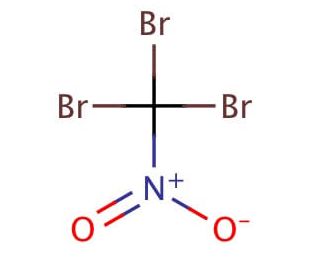

Tribromonitromethane (CAS 464-10-8)
QUICK LINKS
Tribromonitromethane, alternatively referred to as Bromine-Picrin, is a chemical compound consisting of bromine and picric acid. Functionally, Bromopicrin serves as an inhibitor of acetylcholinesterase, an enzyme pivotal in the breakdown of the neurotransmitter acetylcholine. By impeding this enzymatic process, Bromopicrin fosters an elevation in acetylcholine levels, consequently promoting heightened muscle contractions and nerve stimulation. Furthermore, studies have indicated that Bromopicrin exhibits inhibitory effects on monoamine oxidase, an enzyme involved in the degradation of neurotransmitters like serotonin and dopamine. This multifaceted inhibition highlights the potential implications of Bromopicrin in modulating neurotransmitter activity.
Tribromonitromethane (CAS 464-10-8) References
- Hydrogen abstraction and decomposition of bromopicrin and other trihalogenated disinfection byproducts by GC/MS. | Chen, PH., et al. 2002. Environ Sci Technol. 36: 3362-71. PMID: 12188366
- The acute effects of beta3 thienylalanine in the adult male albino rat; observations on nitrogen balance, antibody formation, and tumor growth. | WISSLER, RW., et al. 1956. AMA Arch Pathol. 62: 62-73. PMID: 13326005
- Halonitromethane drinking water disinfection byproducts: chemical characterization and mammalian cell cytotoxicity and genotoxicity. | Plewa, MJ., et al. 2004. Environ Sci Technol. 38: 62-8. PMID: 14740718
- Mutagenicity in Salmonella of halonitromethanes: a recently recognized class of disinfection by-products in drinking water. | Kundu, B., et al. 2004. Mutat Res. 562: 39-65. PMID: 15279829
- Development of normal human colon cell cultures to identify priority unregulated disinfection by-products with a carcinogenic potential. | DeAngelo, AB., et al. 2007. Water Sci Technol. 56: 51-5. PMID: 18075178
- Method for quantifying nitromethane in blood as a potential biomarker of halonitromethane exposure. | Alwis, KU., et al. 2008. Environ Sci Technol. 42: 2522-7. PMID: 18504991
- Determination of halonitromethanes in treated water. | Montesinos, I., et al. 2011. J Chromatogr A. 1218: 2497-504. PMID: 21420095
- Solvent-minimized extraction for determining halonitromethanes and trihalomethanes in water. | Montesinos, I. and Gallego, M. 2012. J Chromatogr A. 1248: 1-8. PMID: 22717036
- Experimental and computational probes of the nature of halogen bonding: complexes of bromine-containing molecules with bromide anions. | Rosokha, SV., et al. 2013. Chemistry. 19: 8774-88. PMID: 23761138
- Halogen bond-assisted electron transfer reactions of aliphatic bromosubstituted electrophiles. | Rosokha, SV. and Vinakos, MK. 2014. Phys Chem Chem Phys. 16: 1809-13. PMID: 24336817
- Induction of bacterial antibiotic resistance by mutagenic halogenated nitrogenous disinfection byproducts. | Lv, L., et al. 2015. Environ Pollut. 205: 291-8. PMID: 26114900
- Biodegradability of DBP precursors after drinking water ozonation. | de Vera, GA., et al. 2016. Water Res. 106: 550-561. PMID: 27771605
- Does Granular Activated Carbon with Chlorination Produce Safer Drinking Water? From Disinfection Byproducts and Total Organic Halogen to Calculated Toxicity. | Cuthbertson, AA., et al. 2019. Environ Sci Technol. 53: 5987-5999. PMID: 31038939
- Formation and transformation of halonitromethanes from dimethylamine in the presence of bromide during the UV/chlorine disinfection. | Deng, L., et al. 2022. Chemosphere. 291: 132731. PMID: 34743802
- A method for the degradation of radioactive nicotinic acid. | Scott, TA. 1967. Biochem J. 102: 87-93. PMID: 6030305
Ordering Information
| Product Name | Catalog # | UNIT | Price | Qty | FAVORITES | |
Tribromonitromethane, 50 mg | sc-396096 | 50 mg | $383.00 |