
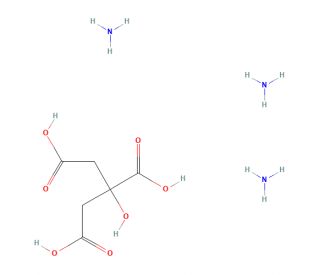

Triammonium citrate (CAS 3458-72-8)
QUICK LINKS
Triammonium citrate is a chemical compound extensively used in various research disciplines, including analytical chemistry, where it acts as a buffering agent to maintain pH stability in a range of chemical reactions. Its chelating properties make it a compound of interest for studies in metal ion complexation, where it is used to understand the behavior of metal ions in solution. Additionally, researchers utilize triammonium citrate in enzymology to investigate its influence on enzymatic activity and stability, as its presence can modulate the activity of certain enzymes. In the field of environmental science, it may be employed in the study of bioremediation processes to sequester heavy metals from contaminated sites. Moreover, its role in nucleation and crystal growth makes it a useful reagent in the synthesis and characterization of novel materials.
Triammonium citrate (CAS 3458-72-8) References
- Effect of impurities on the matrix-assisted laser desorption/ionization mass spectra of insulin. | Bajuk, A., et al. 2001. Rapid Commun Mass Spectrom. 15: 2383-6. PMID: 11746906
- Sodium-tolerant matrix for matrix-assisted laser desorption/ionization mass spectrometry and post-source decay of oligonucleotides. | Lavanant, H. and Lange, C. 2002. Rapid Commun Mass Spectrom. 16: 1928-33. PMID: 12362383
- Precursor effects of citric acid and citrates on ZnO crystal formation. | Cho, S., et al. 2009. Langmuir. 25: 3825-31. PMID: 19708257
- The application of in situ mid-FTIR fibre-optic reflectance spectroscopy and GC-MS analysis to monitor and evaluate painting cleaning. | Kahrim, K., et al. 2009. Spectrochim Acta A Mol Biomol Spectrosc. 74: 1182-8. PMID: 19857991
- Optimization of nutritional and non--nutritional factors involved for production of antimicrobial compounds from Lactobacillus pentosus SJ65 using response surface methodology. | Saraniya, A. and Jeevaratnam, K. 2014. Braz J Microbiol. 45: 81-8. PMID: 24948917
- Pteridine glycosyltransferase from Chlorobium tepidum: crystallization and X-ray analysis. | Killivalavan, A., et al. 2017. Acta Crystallogr F Struct Biol Commun. 73: 629-634. PMID: 29095157
- Extraction and optimization of exopolysaccharide from Lactobacillus sp. using response surface methodology and artificial neural networks. | Suryawanshi, N., et al. 2019. Prep Biochem Biotechnol. 49: 987-996. PMID: 31361180
- Single-sided NMR: a non-invasive diagnostic tool for monitoring swelling effects in paint films subjected to solvent cleaning. | Moretti, P., et al. 2020. Anal Bioanal Chem. 412: 1063-1075. PMID: 31863123
- Characterization and inhibition of four fungi producing citrinin in various culture media. | Gu, S., et al. 2021. Biotechnol Lett. 43: 701-710. PMID: 33386497
- The growth of broiler chickens fed low-protein diets containing triammonium citrate, diammonium hydrogen citrate and autoclaved dried poultry manure. | McNab, JM., et al. 1972. Br Poult Sci. 13: 357-64. PMID: 5044608
- The effect of a single oral dose of nonprotein nitrogen from various sources on amino acid concentrations in the plasma and liver of the chick. | Lee, DJ. and McNab, JM. 1978. Br Poult Sci. 19: 467-73. PMID: 679054
Ordering Information
| Product Name | Catalog # | UNIT | Price | Qty | FAVORITES | |
Triammonium citrate, 100 g | sc-491899 | 100 g | $62.00 |