
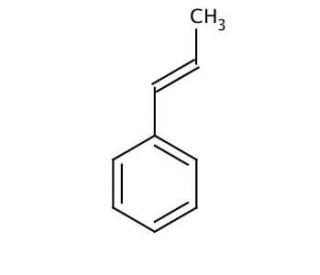

Molecular structure of trans-β-Methylstyrene, CAS Number: 873-66-5
trans-β-Methylstyrene (CAS 873-66-5)
Alternate Names:
trans-1-Phenyl-1-propene; trans-Propenylbenzene
CAS Number:
873-66-5
Molecular Weight:
118.18
Molecular Formula:
C9H10
Supplemental Information:
This is classified as a Dangerous Good for transport and may be subject to additional shipping charges.
For Research Use Only. Not Intended for Diagnostic or Therapeutic Use.
* Refer to Certificate of Analysis for lot specific data.
QUICK LINKS
Ordering Information
Description
Technical Information
Safety Information
SDS & Certificate of Analysis
trans-β-Methylstyrene serves as a highly utilized solvent across various industries and serves as a starting material in numerous organic compound syntheses. Its popularity stems from its advantageous properties, including a low boiling point, low flash point, and low toxicity, making it a favorable option for diverse applications. Furthermore, it has been subject to scientific research, exploring potential applications in biochemical and physiological studies, where it proves useful as a substrate.
trans-β-Methylstyrene (CAS 873-66-5) References
- The synthesis of (R)- and (S)-[N-methyl-11C]beta, beta-difluoromethamphetamine for the investigation of the binding mechanism of biogenic amines in vivo. | Gillings, NM., et al. 1999. Appl Radiat Isot. 50: 707-14. PMID: 10101832
- Monooxygenase activity of cytochrome c peroxidase. | Miller, VP., et al. 1992. J Biol Chem. 267: 8936-42. PMID: 1315745
- Analysis of pyrolysis products of methamphetamine. | Sato, M., et al. 2004. J Anal Toxicol. 28: 638-43. PMID: 15538957
- Relative ototoxicity of 21 aromatic solvents. | Gagnaire, F. and Langlais, C. 2005. Arch Toxicol. 79: 346-54. PMID: 15660228
- Epoxidation of the methamphetamine pyrolysis product, trans-phenylpropene, to trans-phenylpropylene oxide by CYP enzymes and stereoselective glutathione adduct formation. | Sanga, M., et al. 2006. Toxicol Appl Pharmacol. 211: 148-56. PMID: 16038959
- Calorimetric evaluation of polymerization thermokinetics of styrene, alpha-methylstyrene and trans-beta-methylstyrene. | Lin, SY., et al. 2009. J Hazard Mater. 161: 330-5. PMID: 18487015
- Iron vs. ruthenium--a comparison of the stereoselectivity in catalytic olefin epoxidation. | Benet-Buchholz, J., et al. 2009. Dalton Trans. 5910-23. PMID: 19623392
- Epoxidation of alkenes through oxygen activation over a bifunctional CuO/Al2O3 catalyst. | Scotti, N., et al. 2013. Chem Commun (Camb). 49: 1957-9. PMID: 23358661
- Abuse of smoking methamphetamine mixed with tobacco: II. The formation mechanism of pyrolysis products. | Sekine, H. and Nakahara, Y. 1990. J Forensic Sci. 35: 580-90. PMID: 2348176
- Facial triad modelling using ferrous pyridinyl prolinate complexes: synthesis and catalytic applications. | Moelands, MA., et al. 2014. Dalton Trans. 43: 6769-85. PMID: 24647553
- Asymmetric epoxidation of cis/trans-β-methylstyrene catalysed by immobilised Mn(salen) with different linkages: heterogenisation of homogeneous asymmetric catalysis. | Zhang, H., et al. 2014. Chemistry. 20: 7830-41. PMID: 24862233
- Formation and High Reactivity of the anti-Dioxo Form of High-Spin μ-Oxodioxodiiron(IV) as the Active Species That Cleaves Strong C-H Bonds. | Kodera, M., et al. 2016. Chemistry. 22: 5924-36. PMID: 26970337
- Triazolyl, Imidazolyl, and Carboxylic Acid Moieties in the Design of Molybdenum Trioxide Hybrids: Photophysical and Catalytic Behavior. | Lysenko, AB., et al. 2017. Inorg Chem. 56: 4380-4394. PMID: 28368105
- Expoxidation of styrene and substituted styrenes by whole cells of Mycobacterium sp. M156. | Rigby, SR., et al. 1994. Bioorg Med Chem. 2: 553-6. PMID: 8000878
Ordering Information
| Product Name | Catalog # | UNIT | Price | Qty | FAVORITES | |
trans-β-Methylstyrene, 1 g | sc-251263 | 1 g | $46.00 |