
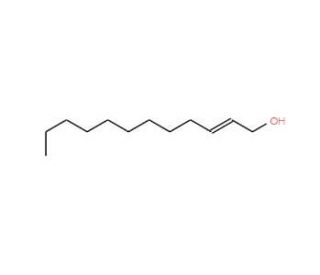

trans-2-Dodecenol (CAS 69064-37-5)
QUICK LINKS
trans-2-Dodecenol is a synthetic fatty alcohol characterized by its linear chain of 12 carbon atoms and a double bond in the trans configuration between the second and third carbons. This unsaturated alcohol is particularly noted for its role as a volatile organic compound in various research settings, especially in the fields of chemical ecology and entomology. Its structure enables it to act as a semiochemical, influencing the behavior of certain insect species. Research has leveraged trans-2-Dodecenol as a pheromonal agent or as part of synthetic lure formulations designed to study insect behavior, monitor populations, or investigate ecological interactions without the implications of direct interference with the organisms′ natural processes. The chemical′s ability to volatilize at relatively low temperatures makes it ideal for use in olfactory-based studies, where it can be dispersed effectively into the environment to simulate natural insect attractants or repellents. Moreover, its utility extends into the study of plant-insect interactions, serving as a tool to understand how certain plant volatiles can affect insect behavior and ecology, providing insights into naturally occurring defense mechanisms or pollination strategies. This compound′s applications in non-medical scientific research underscore its value in advancing our understanding of ecological and biological systems.
trans-2-Dodecenol (CAS 69064-37-5) References
- Current understanding of the molecular players involved in resistance to rice planthoppers. | Ling, Y., et al. 2019. Pest Manag Sci. 75: 2566-2574. PMID: 31095858
- [Determination of each single component vegetable oil in blend oil by headspace gas chromatography-mass spectrometry]. | Wang, Z., et al. 2021. Wei Sheng Yan Jiu. 50: 799-804. PMID: 34749875
- Biomarkers of Metabolic Adaptation to High Dietary Fats in a Mouse Model of Obesity Resistance. | Milhem, F., et al. 2024. Metabolites. 14: PMID: 38276304
- Identification of attractants from plant essential oils for Cyrtorhinus lividipennis, an important predator of rice planthoppers | Siyi Liu, **g Zhao, Chakira Hamada, Wanlun Cai, Musa Khan, Yulan Zou & Hongxia Hua. 2019. Journal of Pest Science. 92: 769–780.
- Behavioral response of Nilaparvata lugens (Stål), Cyrtorhinus lividipennis Reuter and Paederus fuscipes Curtis to three synthetic volatile chemical compounds | Muhammad Musa Khan a, Qing Huang a, Tufail Ahmed Wagan b, Hongxia Hua a, Wanlun Cai a, Jing Zhao a b. 2020. Journal of Asia-Pacific Entomology. 23: 269-276.
- Non-target effects of essential oil-based biopesticides for crop protection: Impact on natural enemies, pollinators, and soil invertebrates | Giulia Giunti a, Giovanni Benelli b, Vincenzo Palmeri c, Francesca Laudani c, Michele Ricupero d, Renato Ricciardi b, Filippo Maggi e, Andrea Lucchi b, Raul Narciso C. Guedes f, Nicolas Desneux g, Orlando Campolo c. 2022. Biological Control. 176.
Ordering Information
| Product Name | Catalog # | UNIT | Price | Qty | FAVORITES | |
trans-2-Dodecenol, 5 ml | sc-296573 | 5 ml | $224.00 |