
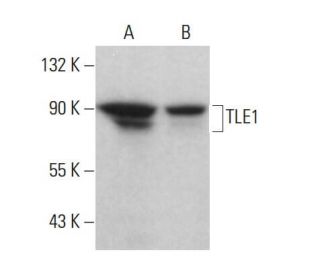
TLE1 Antibody (F-4): sc-137098
- TLE1 Antibody (F-4) is a mouse monoclonal IgG1 κ TLE1 antibody, cited in 1 publications, provided at 200 µg/ml
- raised against amino acids 200-350 of TLE1 of mouse origin
- TLE1 Antibody (F-4) is recommended for detection of TLE1 of mouse, rat and human origin by WB, IP, IF and ELISA
- Anti-TLE1 Antibody (F-4) is available conjugated to agarose for IP; HRP for WB, IHC(P) and ELISA; and to either phycoerythrin or FITC for IF, IHC(P) and FCM
- also available conjugated to Alexa Fluor® 488, Alexa Fluor® 546, Alexa Fluor® 594 or Alexa Fluor® 647 for WB (RGB), IF, IHC(P) and FCM, and for use with RGB fluorescent imaging systems, such as iBright™ FL1000, FluorChem™, Typhoon, Azure and other comparable systems
- also available conjugated to Alexa Fluor® 680 or Alexa Fluor® 790 for WB (NIR), IF and FCM; for use with Near-Infrared (NIR) detection systems, such as LI-COR®Odyssey®, iBright™ FL1000, FluorChem™, Typhoon, Azure and other comparable systems
- TransCruz reagent for Gel Supershift and ChIP applications (sc-137098 X, 200 µg/0.1 ml)
- m-IgG Fc BP-HRP and m-IgG1 BP-HRP are the preferred secondary detection reagents for TLE1 Antibody (F-4) for WB applications. These reagents are now offered in bundles with TLE1 Antibody (F-4) (see ordering information below).

TLE1 Antibody (F-4) is a mouse monoclonal IgG1 kappa light chain antibody that detects TLE1 protein of mouse, rat, and human origin by western blotting (WB), immunoprecipitation (IP), immunofluorescence (IF), and enzyme-linked immunosorbent assay (ELISA). TLE1 (F-4) antibody is available in both non-conjugated and various conjugated forms, including agarose, horseradish peroxidase (HRP), phycoerythrin (PE), fluorescein isothiocyanate (FITC), and multiple Alexa Fluor® conjugates. TLE1, also known as Enhancer of Split Groucho-like protein 1 (ESG1), plays a crucial role in the Notch signaling pathway, which is essential for regulating cellular interactions that determine cell fate during development in both invertebrates and vertebrates. TLE1 functions as a transcriptional repressor, interacting with chromatin and specifically binding to Histone H3, thereby influencing gene expression during neurogenesis, segmentation, and sex determination. TLE1 is involved in the differentiation of epithelial cells, with expression correlating with immature epithelial cells transitioning toward a terminally differentiated state. Elevated levels of TLE1, along with TLE2 and TLE3, have been observed in cervical squamous metaplasias and carcinomas, highlighting a potential role in cancer biology. TLE1 contains SP and WD40 domains, which facilitate interaction with other proteins, such as AML1, to inhibit transactivation of the CSF1 receptor. Dynamic expression patterns of TLE1, TLE2, and TLE4 during various stages of cell differentiation underscore the complexity of regulatory roles in cellular processes.
Alexa Fluor® is a trademark of Molecular Probes Inc., OR., USA
LI-COR® and Odyssey® are registered trademarks of LI-COR Biosciences
TLE1 Antibody (F-4) References:
- Human homologs of a Drosophila Enhancer of split gene product define a novel family of nuclear proteins. | Stifani, S., et al. 1992. Nat Genet. 2: 119-27. PMID: 1303260
- Molecular recognition of transcriptional repressor motifs by the WD domain of the Groucho/TLE corepressor. | Jennings, BH., et al. 2006. Mol Cell. 22: 645-55. PMID: 16762837
- TLE1 as a diagnostic immunohistochemical marker for synovial sarcoma emerging from gene expression profiling studies. | Terry, J., et al. 2007. Am J Surg Pathol. 31: 240-6. PMID: 17255769
- Aristaless-related homeobox gene, the gene responsible for West syndrome and related disorders, is a Groucho/transducin-like enhancer of split dependent transcriptional repressor. | McKenzie, O., et al. 2007. Neuroscience. 146: 236-47. PMID: 17331656
- Ras-Erk signaling induces phosphorylation of human TLE1 and downregulates its repressor function. | Zahavi, T., et al. 2017. Oncogene. 36: 3729-3739. PMID: 28192406
- TLE1 inhibits anoikis and promotes tumorigenicity in human lung cancer cells through ZEB1-mediated E-cadherin repression. | Yao, X., et al. 2017. Oncotarget. 8: 72235-72249. PMID: 29069783
- Foxq1 Promotes Alveolar Epithelial Cell Death through Tle1-mediated Inhibition of the NF-κB Signaling Pathway. | Zhu, X., et al. 2024. Am J Respir Cell Mol Biol. 71: 53-65. PMID: 38574238
- Groucho is required for Drosophila neurogenesis, segmentation, and sex determination and interacts directly with hairy-related bHLH proteins. | Paroush, Z., et al. 1994. Cell. 79: 805-15. PMID: 8001118
- Epithelial expression and chromosomal location of human TLE genes: implications for notch signaling and neoplasia. | Liu, Y., et al. 1996. Genomics. 31: 58-64. PMID: 8808280
- The Groucho/transducin-like enhancer of split transcriptional repressors interact with the genetically defined amino-terminal silencing domain of histone H3. | Palaparti, A., et al. 1997. J Biol Chem. 272: 26604-10. PMID: 9334241
- Combinatorial expression patterns of individual TLE proteins during cell determination and differentiation suggest non-redundant functions for mammalian homologs of Drosophila Groucho. | Yao, J., et al. 1998. Dev Growth Differ. 40: 133-46. PMID: 9572356
- Transcriptional repression by AML1 and LEF-1 is mediated by the TLE/Groucho corepressors. | Levanon, D., et al. 1998. Proc Natl Acad Sci U S A. 95: 11590-5. PMID: 9751710
Ordering Information
| Product Name | Catalog # | UNIT | Price | Qty | FAVORITES | |
TLE1 Antibody (F-4) | sc-137098 | 200 µg/ml | $322.00 | |||
TLE1 Antibody (F-4): m-IgG Fc BP-HRP Bundle | sc-527121 | 200 µg Ab; 10 µg BP | $361.00 | |||
TLE1 Antibody (F-4): m-IgG1 BP-HRP Bundle | sc-532494 | 200 µg Ab; 20 µg BP | $361.00 | |||
TLE1 Antibody (F-4) X | sc-137098 X | 200 µg/0.1 ml | $322.00 | |||
TLE1 Antibody (F-4) AC | sc-137098 AC | 500 µg/ml, 25% agarose | $424.00 | |||
TLE1 Antibody (F-4) HRP | sc-137098 HRP | 200 µg/ml | $322.00 | |||
TLE1 Antibody (F-4) FITC | sc-137098 FITC | 200 µg/ml | $336.00 | |||
TLE1 Antibody (F-4) PE | sc-137098 PE | 200 µg/ml | $349.00 | |||
TLE1 Antibody (F-4) Alexa Fluor® 488 | sc-137098 AF488 | 200 µg/ml | $364.00 | |||
TLE1 Antibody (F-4) Alexa Fluor® 546 | sc-137098 AF546 | 200 µg/ml | $364.00 | |||
TLE1 Antibody (F-4) Alexa Fluor® 594 | sc-137098 AF594 | 200 µg/ml | $364.00 | |||
TLE1 Antibody (F-4) Alexa Fluor® 647 | sc-137098 AF647 | 200 µg/ml | $364.00 | |||
TLE1 Antibody (F-4) Alexa Fluor® 680 | sc-137098 AF680 | 200 µg/ml | $364.00 | |||
TLE1 Antibody (F-4) Alexa Fluor® 790 | sc-137098 AF790 | 200 µg/ml | $364.00 |