
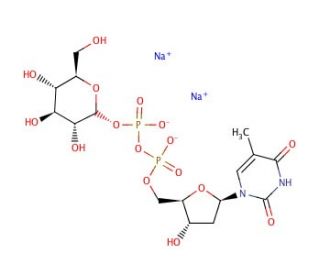

Thymidine-5′-diphospho-α-D-glucose disodium salt (CAS 148296-43-9)
QUICK LINKS
Thymidine-5′-diphospho-α-D-glucose disodium salt (TDP alpha-glucose) is a sugar-nucleotide naturally existing in numerous organisms, including humans. Its involvement spans a range of biochemical and physiological processes such as DNA and RNA synthesis, energy metabolism, and cell signaling. This compound presents a range of applications in scientific research. For instance, it aids in examining the structure and functionality of enzymes implicated in DNA and RNA synthesis, energy metabolism, and cell signaling. Moreover, it contributes to research investigating drug mechanisms of action and gene expression regulation. Proteins engaged in energy metabolism and cell signaling can also be studied using this compound. Thymidine-5′-diphospho-α-D-glucose disodium salt plays a role as an intermediate in the creation of nucleotides and energy metabolism. During DNA and RNA synthesis, it serves as a substrate for the enzyme thymidylate synthase, facilitating the production of thymidine monophosphate (TMP), an essential component in DNA and RNA synthesis. In the context of energy metabolism, this compound is employed as a substrate for the enzyme glyceraldehyde 3-phosphate dehydrogenase, leading to the formation of 1,3-bisphosphoglycerate (1,3-BPG), a critical player in ATP synthesis. In cell signaling, Thymidine-5′-diphospho-α-D-glucose disodium salt is utilized as a substrate for the enzyme protein kinase C, which facilitates protein phosphorylation.
Ordering Information
| Product Name | Catalog # | UNIT | Price | Qty | FAVORITES | |
Thymidine-5′-diphospho-α-D-glucose disodium salt, 25 mg | sc-215982 | 25 mg | $520.00 |