
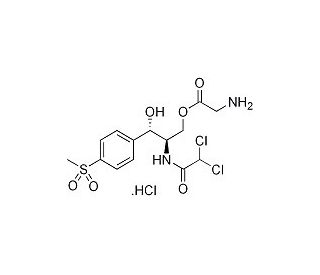

Thiamphenicol Glycinate hydrochloride (CAS 2611-61-2)
QUICK LINKS
Thiamphenicol glycinate hydrochloride is a glycinate ester derivative of thiamphenicol, which itself is a methyl-sulfonyl analogue of chloramphenicol, and is employed primarily for its bacteriostatic effects in research settings. The compound functions by targeting the bacterial ribosome, specifically binding to the 50S subunit, which is crucial for protein synthesis. By attaching to this subunit, thiamphenicol glycinate hydrochloride inhibits peptidyl transferase activity, effectively blocking the peptide bond formation that is essential for linking amino acids during the translation process. This interruption halts bacterial protein synthesis, thereby impeding bacterial growth. In scientific research, thiamphenicol glycinate hydrochloride is utilized to investigate the mechanisms of action of bacteriostatic agents and their specific interactions with ribosomal components. Its role in inhibiting protein synthesis makes it a useful tool for studying ribosomal function and the effects of modifications on ribosomal resistance to antibiotics. Additionally, this compound assists in understanding how structural changes in antibiotics influence their efficacy and the development of resistance mechanisms in bacteria. Research involving thiamphenicol glycinate hydrochloride contributes to broader insights into microbial physiology and the underlying molecular basis of action of synthetic antibacterial agents.
Thiamphenicol Glycinate hydrochloride (CAS 2611-61-2) References
- Activity of aerosol thiamphenicol glycinate acetylcysteinate in a mouse model of S. pyogenes pneumonia. | Albini, E., et al. 1999. Arzneimittelforschung. 49: 631-4. PMID: 10442213
- A comparative kinetic study of thiamphenicol in pre-ruminant lambs and calves. | Mengozzi, G., et al. 2002. Res Vet Sci. 73: 291-5. PMID: 12443688
- Comparsion of an immunochromatographic strip with ELISA for simultaneous detection of thiamphenicol, florfenicol and chloramphenicol in food samples. | Guo, L., et al. 2015. Biomed Chromatogr. 29: 1432-9. PMID: 25675893
- pH-Controlled Drug Release by Diffusion through Silica Nanochannel Membranes. | Zhao, M., et al. 2018. ACS Appl Mater Interfaces. 10: 33986-33992. PMID: 30211527
- Development of a multicomponent immunochromatographic test system for the detection of fluoroquinolone and amphenicol antibiotics in dairy products. | Hendrickson, OD., et al. 2019. J Sci Food Agric. 99: 3834-3842. PMID: 30680731
- Silica Nanochannel Membranes for Electrochemical Analysis and Molecular Sieving: A Comprehensive Review. | Zhou, P., et al. 2020. Crit Rev Anal Chem. 50: 424-444. PMID: 31352789
- Molecular Complementarity of Proteomimetic Materials for Target-Specific Recognition and Recognition-Mediated Complex Functions. | Kim, M., et al. 2023. Adv Mater. 35: e2208309. PMID: 36525617
- Effect of consecutive dosing of thiamphenicol on its own serm concentration and liver drug metabolizing enzyme activities. | Ogo, T., et al. 1972. Jpn J Pharmacol. 22: 427-31. PMID: 4539401
- [Technological problems concerning the lyophilization of thiamphenicol glycinate hydrochloride]. | Stampf, G., et al. 1978. Acta Pharm Hung. 48: 85-90. PMID: 654923
- Temporary nasosinusal drainage and lavage in chronic maxillary sinusitis. Statistical study on 847 maxillary sinuses. | Bertrand, B. and Eloy, P. 1993. Ann Otol Rhinol Laryngol. 102: 858-62. PMID: 8239346
Ordering Information
| Product Name | Catalog # | UNIT | Price | Qty | FAVORITES | |
Thiamphenicol Glycinate hydrochloride, 1 g | sc-204914 | 1 g | $58.00 | |||
Thiamphenicol Glycinate hydrochloride, 5 g | sc-204914A | 5 g | $204.00 |