
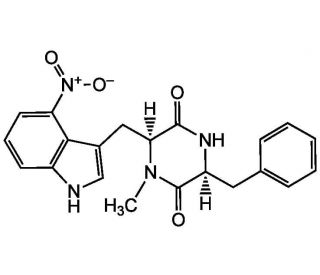

Thaxtomin C (CAS 140111-05-3)
QUICK LINKS
Thaxtomin C, a phytotoxin produced by plant-pathogenic Streptomyces species, is a key agent in the study of plant-microbe interactions, particularly in the context of plant disease. Structurally, thaxtomin C is characterized by a nitrophenylalanine moiety, which is critical for its activity as a natural herbicide. This chemical inhibits cellulose biosynthesis in plants, leading to cell wall destabilization and subsequent plant tissue necrosis. By targeting the cellulose synthase enzymes, thaxtomin C disrupts the primary cell wall formation, which is vital for plant growth and stability. Research involving thaxtomin C is significant in understanding the molecular basis of pathogenicity and the defense mechanisms in plants against microbial attack. This phytotoxin has been extensively used in studies aiming to explain the signaling pathways activated in response to toxin exposure and the genetic bases of plant resistance or susceptibility to pathogen-induced diseases. Moreover, thaxtomin C serves as a model compound for developing new bioherbicides based on its mode of action, contributing to agricultural biotechnology by offering insights into creating more targeted and environmentally friendly pest management strategies. Thus, its role extends beyond a simple pathogenic factor to a tool for advanced research in plant pathology and agronomic improvement.
Thaxtomin C (CAS 140111-05-3) References
- Herbicidal properties of the thaxtomin group of phytotoxins. | King, RR., et al. 2001. J Agric Food Chem. 49: 2298-301. PMID: 11368592
- Influence of thaxtomins in different combinations and concentrations on growth of micropropagated potato shoot cultures. | Hiltunen, LH., et al. 2006. J Agric Food Chem. 54: 3372-9. PMID: 16637698
- The thaxtomin phytotoxins: sources, synthesis, biosynthesis, biotransformation and biological activity. | King, RR. and Calhoun, LA. 2009. Phytochemistry. 70: 833-41. PMID: 19467551
- Evidence that thaxtomin C is a pathogenicity determinant of Streptomyces ipomoeae, the causative agent of Streptomyces soil rot disease of sweet potato. | Guan, D., et al. 2012. Mol Plant Microbe Interact. 25: 393-401. PMID: 22088193
- The cellobiose sensor CebR is the gatekeeper of Streptomyces scabies pathogenicity. | Francis, IM., et al. 2015. mBio. 6: e02018. PMID: 25714708
- Synthesis and biological evaluations of a series of thaxtomin analogues. | Zhang, H., et al. 2015. J Agric Food Chem. 63: 3734-41. PMID: 25804187
- High-Yield Production of Herbicidal Thaxtomins and Thaxtomin Analogs in a Nonpathogenic Streptomyces Strain. | Jiang, G., et al. 2018. Appl Environ Microbiol. 84: PMID: 29602787
- Engineered biosynthesis of thaxtomin phytotoxins. | Wang, L., et al. 2020. Crit Rev Biotechnol. 40: 1163-1171. PMID: 32819175
- Comparative genomics of the niche-specific plant pathogen Streptomyces ipomoeae reveal novel genome content and organization. | Soares, NR., et al. 2023. Appl Environ Microbiol. 89: e0030823. PMID: 38009923
- Isolation and characterization of thaxtomin-type phytotoxins associated with Streptomyces ipomoeae. | King, R. R., et al. 1994. Journal of Agricultural and Food Chemistry. 42(8): 1791-1794.
Ordering Information
| Product Name | Catalog # | UNIT | Price | Qty | FAVORITES | |
Thaxtomin C, 1 mg | sc-364220 | 1 mg | $321.00 | |||
Thaxtomin C, 5 mg | sc-364220A | 5 mg | $1072.00 |