
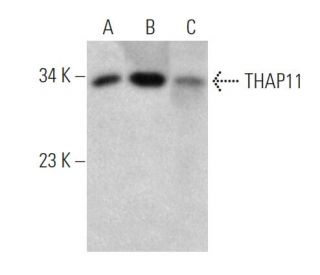

THAP11 Antibody (364CT25.4.2): sc-517366
- THAP11 Antibody (364CT25.4.2) is a mouse monoclonal IgM THAP11 antibody, cited in 1 publications, provided at 100 µg/ml
- raised against a synthetic peptide corresponding to amino acids 165-193 in a central region of THAP11 of human origin
- recommended for detection of THAP11 of mouse, rat and human origin by WB and IP
- At present, we have not yet completed the identification of the preferred secondary detection reagent(s) for THAP11 Antibody (364CT25.4.2). This work is in progress.

QUICK LINKS
THAP11 Antibody (364CT25.4.2) is a mouse monoclonal IgM antibody that detects THAP11 protein of mouse, rat, and human origin by western blotting (WB) and immunoprecipitation (IP). THAP11 (364CT25.4.2) antibody is available as a non-conjugated anti-THAP11 monoclonal isotype antibody. THAP11, also known as HRIHFB2206, is a 314 amino acid member of the THAP family, characterized by the presence of a conserved THAP-type zinc finger motif that plays a crucial role in DNA binding. This motif is essential for THAP11′s function in transcriptional regulation, cell-cycle control, apoptosis, and chromatin modification, highlighting THAP11′s importance in cellular processes. THAP11 is primarily localized in the nucleus and cytoplasm, where THAP11 may function as a transcriptional repressor, influencing embryogenesis and pluripotency of embryonic stem cells by recruiting epigenetic modifiers. THAP11 interacts with HCF1 through a coiled coil domain, which is significant for regulatory functions and potential implications in developmental biology and disease states.
Alexa Fluor® is a trademark of Molecular Probes Inc., OR., USA
LI-COR® and Odyssey® are registered trademarks of LI-COR Biosciences
THAP11 Antibody (364CT25.4.2) References:
- The THAP domain: a novel protein motif with similarity to the DNA-binding domain of P element transposase. | Roussigne, M., et al. 2003. Trends Biochem Sci. 28: 66-9. PMID: 12575992
- THAP1 is a nuclear proapoptotic factor that links prostate-apoptosis-response-4 (Par-4) to PML nuclear bodies. | Roussigne, M., et al. 2003. Oncogene. 22: 2432-42. PMID: 12717420
- SMARCA2 and THAP11: potential candidates for polyglutamine disorders as evidenced from polymorphism and protein-folding simulation studies. | Pandey, N., et al. 2004. J Hum Genet. 49: 596-602. PMID: 15368101
- Human THAP7 is a chromatin-associated, histone tail-binding protein that represses transcription via recruitment of HDAC3 and nuclear hormone receptor corepressor. | Macfarlan, T., et al. 2005. J Biol Chem. 280: 7346-58. PMID: 15561719
- Solution structure of the THAP domain from Caenorhabditis elegans C-terminal binding protein (CtBP). | Liew, CK., et al. 2007. J Mol Biol. 366: 382-90. PMID: 17174978
- Ronin is essential for embryogenesis and the pluripotency of mouse embryonic stem cells. | Dejosez, M., et al. 2008. Cell. 133: 1162-74. PMID: 18585351
- Cell growth suppression by thanatos-associated protein 11(THAP11) is mediated by transcriptional downregulation of c-Myc. | Zhu, CY., et al. 2009. Cell Death Differ. 16: 395-405. PMID: 19008924
Ordering Information
| Product Name | Catalog # | UNIT | Price | Qty | FAVORITES | |
THAP11 Antibody (364CT25.4.2) | sc-517366 | 100 µg/ml | $322.00 |