
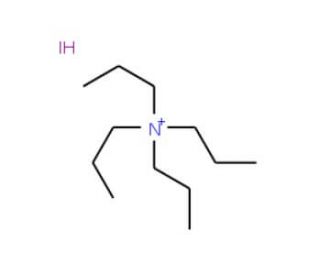

Tetrapropylammonium iodide (CAS 631-40-3)
QUICK LINKS
Tetrapropylammonium iodide (TPAI) is an inorganic compound characterized by four propyl groups attached to a central iodide ion. It presents as a white solid with solubility in both water and organic solvents. Tetrapropylammonium iodide finds extensive utilization in various scientific research applications, encompassing organic synthesis, catalysis, and electrochemistry. Furthermore, it serves as a valuable reagent in biochemical assays and an electrolyte in electrochemical experiments. It acts as a reagent in biochemical assays and facilitates electrolyte-based investigations. Tetrapropylammonium iodide has contributed significantly to the synthesis of organic compounds such as amides, esters, and heterocycles. Moreover, it serves as a catalyst in diverse reactions, including the Heck reaction, the Suzuki reaction, and the Sonogashira coupling. Additionally, Tetrapropylammonium iodide is employed in electrochemical experiments for tasks like determining redox potentials. Being an ionic compound with a positive charge, Tetrapropylammonium iodide exhibits strong Lewis acid properties. This enables it to react with electron-rich molecules like amines and alcohols, leading to the formation of adducts. Additionally, Tetrapropylammonium iodide can function as a proton donor, facilitating reactions with electron-deficient molecules such as aldehydes and ketones, resulting in adduct formation.
Tetrapropylammonium iodide (CAS 631-40-3) References
- Ion-pair chromatography of polythionates and thiosulfate with detection based on their catalytic effects on the postcolumn azide-iodine reaction. | Miura, Y. and Watanabe, M. 2001. J Chromatogr A. 920: 163-71. PMID: 11452995
- Improvement of N-phthaloylchitosan based gel polymer electrolyte in dye-sensitized solar cells using a binary salt system. | Yusuf, SNF., et al. 2017. Carbohydr Polym. 157: 938-944. PMID: 27988011
- Tuning up the photovoltaic performances upon the utility of diketopyrrolopyrrole in PEO-based gel polymer electrolytes. | Kumar, S., et al. 2021. Dalton Trans. 50: 7647-7655. PMID: 33973615
- Pure White Emission with 91.9% Photoluminescence Quantum Yield of [(C3H7)4N]2Cu2I4 out of Polaronic States and Ultra-High Color Rendering Index. | Peng, H., et al. 2022. ACS Appl Mater Interfaces. 14: 12395-12403. PMID: 35235303
- Electrocatalytic and structural properties and computational calculation of PAN-EC-PC-TPAI-I2 gel polymer electrolytes for dye sensitized solar cell application. | Chowdhury, FI., et al. 2021. RSC Adv. 11: 22937-22950. PMID: 35480423
- Modification of DSSC Based on Polymer Composite Gel Electrolyte with Copper Oxide Nanochain by Shape Effect. | Farhana, NK., et al. 2022. Polymers (Basel). 14: PMID: 36015683
- Structural, Optical, and Electrical Parameters of Doped PVA/PVP Blend with TPAI or THAI Salt. | El-Naggar, AM., et al. 2023. Polymers (Basel). 15: PMID: 37376307
Ordering Information
| Product Name | Catalog # | UNIT | Price | Qty | FAVORITES | |
Tetrapropylammonium iodide, 25 g | sc-251216 | 25 g | $79.00 |