
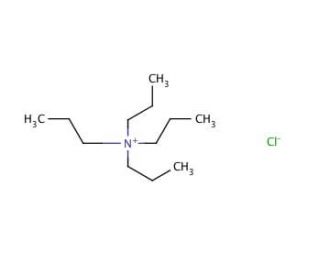

Molecular structure of Tetrapropylammonium chloride, CAS Number: 5810-42-4
Tetrapropylammonium chloride (CAS 5810-42-4)
Alternate Names:
Tetra-n-propylammonium chloride; n,n,n-tripropylpropan-1-aminium chloride
CAS Number:
5810-42-4
Purity:
98%
Molecular Weight:
221.81
Molecular Formula:
(CH3CH2CH2)4N•Cl
For Research Use Only. Not Intended for Diagnostic or Therapeutic Use.
* Refer to Certificate of Analysis for lot specific data.
QUICK LINKS
Ordering Information
Description
Technical Information
Safety Information
SDS & Certificate of Analysis
Tetrapropylammonium chloride (TPAC) is an organic salt composed of four propyl groups attached to an ammonium ion. It is used in a variety of applications, from laboratory research to industrial processes. In the laboratory, Tetrapropylammonium chlorid is used as a Lewis acid catalyst in organic synthesis and as an activator for a variety of reactions. In industry, Tetrapropylammonium chlorid is used as a corrosion inhibitor, an antifreeze, and as a component of a variety of cleaning agents.
Tetrapropylammonium chloride (CAS 5810-42-4) References
- Specificity of ion-protein interactions: complementary and competitive effects of tetrapropylammonium, guanidinium, sulfate, and chloride ions. | Mason, PE., et al. 2009. J Phys Chem B. 113: 3227-34. PMID: 19708168
- Pharmaceutical modulation of diffusion potentials at aqueous-aqueous boundaries under laminar flow conditions. | Collins, CJ., et al. 2011. Electrophoresis. 32: 844-9. PMID: 21437916
- Complex ion effects on polypeptide conformational stability: chloride and sulfate salts of guanidinium and tetrapropylammonium. | Dempsey, CE., et al. 2011. J Am Chem Soc. 133: 7300-3. PMID: 21520945
- Why do tetrapropylammonium chloride and sulphate salts destabilize the native state of globular proteins? | Graziano, G. 2014. ScientificWorldJournal. 2014: 870106. PMID: 24616650
- Thin and long silver nanowires self-assembled in ionic liquids as a soft template: electrical and optical properties. | Chang, MH., et al. 2014. Nanoscale Res Lett. 9: 330. PMID: 25024690
- Quantifying chloride binding and salt extraction with poly(methyl methacrylate) copolymers bearing aryl-triazoles as anion receptor side chains. | McDonald, KP., et al. 2014. Chem Commun (Camb). 50: 13285-8. PMID: 25233076
- Do guanidinium and tetrapropylammonium ions specifically interact with aromatic amino acid side chains? | Ding, B., et al. 2017. Proc Natl Acad Sci U S A. 114: 1003-1008. PMID: 28096375
- Anomalous surface behavior of hydrated guanidinium ions due to ion pairing. | Ekholm, V., et al. 2018. J Chem Phys. 148: 144508. PMID: 29655316
- Mesoporous Titanium-Silicalite Zeolite Containing Organic Templates as a Bifunctional Catalyst for Cycloaddition of CO2 and Epoxides. | Liu, D., et al. 2018. ACS Appl Mater Interfaces. 10: 22119-22129. PMID: 29896960
- The Role of Charge Transfer in the Formation of Type I Deep Eutectic Solvent-Analogous Ionic Liquid Mixtures. | Abranches, DO., et al. 2019. Molecules. 24: PMID: 31614959
- Modulation of cytotoxicity by consecutive adsorption of tannic acid and pesticides on surfactant functionalized zeolites. | Jevremović, A., et al. 2020. Environ Sci Process Impacts. 22: 2199-2211. PMID: 32975257
- ATP-sensitive K+ channel opener acts as a potent Cl- channel inhibitor in vascular smooth muscle cells. | Holevinsky, KO., et al. 1994. J Membr Biol. 137: 59-70. PMID: 8006946
- Kinetics of the inhibition of the Na-K pump by tetrapropylammonium chloride. | Kropp, DL. and Sachs, JR. 1977. J Physiol. 264: 471-87. PMID: 839463
Ordering Information
| Product Name | Catalog # | UNIT | Price | Qty | FAVORITES | |
Tetrapropylammonium chloride, 10 g | sc-251214 | 10 g | $44.00 |