
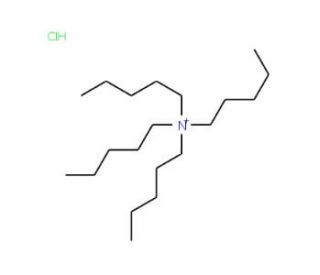

Molecular structure of Tetrapentylammonium chloride, CAS Number: 4965-17-7
Tetrapentylammonium chloride (CAS 4965-17-7)
See product citations (1)
CAS Number:
4965-17-7
Purity:
≥97%
Molecular Weight:
334.02
Molecular Formula:
C20H44ClN
Supplemental Information:
This is classified as a Dangerous Good for transport and may be subject to additional shipping charges.
For Research Use Only. Not Intended for Diagnostic or Therapeutic Use.
* Refer to Certificate of Analysis for lot specific data.
QUICK LINKS
Ordering Information
Product Citations
Description
Technical Information
Safety Information
SDS & Certificate of Analysis
Tetrapentylammonium chloride acts as a surfactant, facilitating the creation of liposomes for the study of delivery systems. Tetrapentylammonium chloride acts as a solubilizing agent for proteins, peptides, and other large molecules, aiding in their analysis. Tetrapentylammonium chloride also plays a role in investigating the properties of proteins, enzymes, and other biological substances. Its ionic surfactant nature enables it to lower the surface tension and enhance solubility of solutions.
Tetrapentylammonium chloride (CAS 4965-17-7) References
- Electrophysiological and pharmacological characterization of K+-currents in muscle fibres isolated from the ventral sucker of Fasciola hepatica. | Kumar, D., et al. 2004. Parasitology. 129: 779-93. PMID: 15648701
- Sites of action of hydrogen peroxide on ion transport across rat distal colon. | Schultheiss, G., et al. 2008. Br J Pharmacol. 154: 991-1000. PMID: 18587445
- Actions of hydrogen sulphide on ion transport across rat distal colon. | Hennig, B. and Diener, M. 2009. Br J Pharmacol. 158: 1263-75. PMID: 19785650
- The pore structure and gating mechanism of K2P channels. | Piechotta, PL., et al. 2011. EMBO J. 30: 3607-19. PMID: 21822218
- Receptors and mechanisms mediating the biphasic response evoked by bradykinin in rat colonic smooth muscle. | Würner, L. and Diener, M. 2013. Neurogastroenterol Motil. 25: e581-90. PMID: 23742018
- A Non-canonical Voltage-Sensing Mechanism Controls Gating in K2P K(+) Channels. | Schewe, M., et al. 2016. Cell. 164: 937-49. PMID: 26919430
- Sodium permeable and 'hypersensitive' TREK-1 channels cause ventricular tachycardia. | Decher, N., et al. 2017. EMBO Mol Med. 9: 403-414. PMID: 28242754
- Bilayer-Mediated Structural Transitions Control Mechanosensitivity of the TREK-2 K2P Channel. | Aryal, P., et al. 2017. Structure. 25: 708-718.e2. PMID: 28392258
- Kca3.1 Activation Via P2y2 Purinergic Receptors Promotes Human Ovarian Cancer Cell (Skov-3) Migration. | Robles-Martínez, L., et al. 2017. Sci Rep. 7: 4340. PMID: 28659615
- The molecular basis for an allosteric inhibition of K+-flux gating in K2P channels. | Rinné, S., et al. 2019. Elife. 8: PMID: 30803485
- The versatile regulation of K2P channels by polyanionic lipids of the phosphoinositide and fatty acid metabolism. | Riel, EB., et al. 2022. J Gen Physiol. 154: PMID: 34928298
- Characterisation of C101248: A novel selective THIK-1 channel inhibitor for the modulation of microglial NLRP3-inflammasome. | Ossola, B., et al. 2023. Neuropharmacology. 224: 109330. PMID: 36375694
- Dissociation between electrical and mechanical responses to nitrergic stimulation in the canine gastric fundus. | Bayguinov, O. and Sanders, KM. 1998. J Physiol. 509 (Pt 2): 437-48. PMID: 9575293
- Nitric oxide suppresses a Ca(2+)-stimulated Cl- current in smooth muscle cells of opossum esophagus. | Zhang, Y., et al. 1998. Am J Physiol. 274: G886-90. PMID: 9612270
Ordering Information
| Product Name | Catalog # | UNIT | Price | Qty | FAVORITES | |
Tetrapentylammonium chloride, 5 g | sc-251210 | 5 g | $306.00 |