
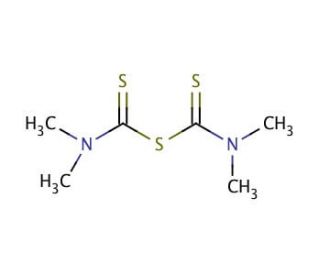

Tetramethylthiuram monosulfide (CAS 97-74-5)
QUICK LINKS
Tetramethylthiuram monosulfide (TMTMS) is a thiuram compound. It presents as a white crystalline solid with a melting point of 111°C and a boiling point of 250°C. As a highly reactive compound, Tetramethylthiuram monosulfide has found application in synthesizing a diverse range of compounds. Tetramethylthiuram monosulfide has been instrumental in material development and investigating biochemical and physiological effects. Its versatility has facilitated the development of novel materials and the exploration of biochemical and physiological effects. The mechanism of action of Tetramethylthiuram monosulfide involves inhibiting enzymes responsible for protein and nucleic acid synthesis. By binding to the enzyme′s active site, it hinders catalysis of the reaction. Thus, it effectively disrupts the enzyme′s function by occupying its active site and preventing the catalytic reaction.
Tetramethylthiuram monosulfide (CAS 97-74-5) References
- Allergic contact dermatitis caused by dimethylthiocarbamylbenzothiazole sulfide (DMTBS) in canvas shoes: in search of the culprit allergen. | Schuttelaar, ML., et al. 2018. Contact Dermatitis. 78: 7-11. PMID: 28776709
- Novel therapeutic features of disulfiram against hepatocellular carcinoma cells with inhibitory effects on a disintegrin and metalloproteinase 10. | Goto, K., et al. 2018. Oncotarget. 9: 18821-18831. PMID: 29721164
- Allergic contact dermatitis caused by elastic bands from FFP2 mask. | Navarro-Triviño, FJ., et al. 2020. Contact Dermatitis. 83: 168-169. PMID: 32406110
- Occupational dermatitis to facial personal protective equipment in health care workers: A systematic review. | Yu, J., et al. 2021. J Am Acad Dermatol. 84: 486-494. PMID: 33011325
- Allergic contact dermatitis to rubber accelerators in protective gloves: Problems, challenges, and solutions for occupational skin protection. | Hansen, A., et al. 2021. Allergol Select. 5: 335-344. PMID: 34734158
- Development of high slip-resistant footwear outsole using rubber surface filled with activated carbon/sodium chloride. | Nishi, T., et al. 2022. Sci Rep. 12: 267. PMID: 34997085
- Copper-Promoted Hiyama Cross-Coupling of Arylsilanes With Thiuram Reagents: A Facile Synthesis of Aryl Dithiocarbamates. | Wang, Y., et al. 2022. Front Chem. 10: 867806. PMID: 35559223
- Patch testing with the European baseline series and 10 added allergens: Single-centre study of 748 patients. | Bizjak, M., et al. 2022. Contact Dermatitis. 87: 439-446. PMID: 35736503
- The additive value of patch testing non-commercial test substances and patients' own products in a clinic of occupational dermatology. | Aalto-Korte, K. and Pesonen, M. 2023. Contact Dermatitis. 88: 27-34. PMID: 35864599
- ATF3/SPI1/SLC31A1 Signaling Promotes Cuproptosis Induced by Advanced Glycosylation End Products in Diabetic Myocardial Injury. | Huo, S., et al. 2023. Int J Mol Sci. 24: PMID: 36675183
- Occupational Hand Dermatitis. | Karagounis, TK. and Cohen, DE. 2023. Curr Allergy Asthma Rep. 23: 201-212. PMID: 36749448
- Nickel-Catalyzed Amidation of Aryl Alkynyl Acids with Tetraalkylthiuram Disulfides: A Facile Synthesis of Aryl Alkynyl Amides. | Wang, L., et al. 2023. ACS Omega. 8: 7699-7713. PMID: 36872968
- Active sensitization to dimethylthiocarbamylbenzothiazol sulphide: An unexpectedly strong rubber contact allergen. | Isaksson, M., et al. 2023. Contact Dermatitis. 88: 472-479. PMID: 36975130
Ordering Information
| Product Name | Catalog # | UNIT | Price | Qty | FAVORITES | |
Tetramethylthiuram monosulfide, 100 g | sc-229438 | 100 g | $88.00 |