
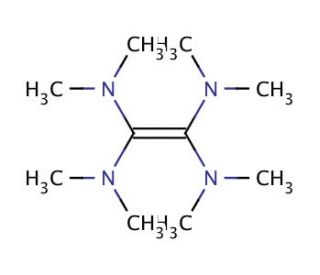

Tetrakis(dimethylamino)ethylene (CAS 996-70-3)
QUICK LINKS
Tetrakis(dimethylamino)ethylene, also known as TDAE, is a synthetic organic compound that finds widespread applications in scientific research. This colorless, volatile liquid emits a mild odor and exhibits solubility in water, alcohol, and ether. As a member of quaternary ammonium compounds, it possesses a ring structure with four nitrogen atoms connected to four organic groups, resulting in a positively charged ionic compound. Tetrakis(dimethylamino)ethylene possesses several desirable properties for scientific investigation, including its versatility in various solvents, low toxicity, and cost-effectiveness. Tetrakis(dimethylamino)ethylene has diverse applications in scientific research. It acts as an enzyme inhibitor, particularly targeting proteases involved in protein breakdown. Moreover, it is instrumental in studying ion channels that regulate the flow of ions across cell membranes. Additionally, Tetrakis(dimethylamino)ethylene plays a vital role in investigating cell signaling pathways that govern intercellular communication. Furthermore, it is employed in studying DNA binding proteins that control gene expression. Lastly, Tetrakis(dimethylamino)ethylene is pivotal in exploring receptor-ligand interactions, which influence cell behavior by regulating protein interactions with other molecules. The mechanism of Tetrakis(dimethylamino)ethylene involves binding to the active sites of enzymes, ion channels, and various proteins, effectively blocking their activity. Specifically, it forms complexes with protease active sites, preventing protein breakdown. Consequently, this interaction can have diverse effects on cell behavior, including the preservation of certain proteins involved in cell signaling pathways, thereby inducing changes in cellular responses. Furthermore, Tetrakis(dimethylamino)ethylene′s binding to DNA binding proteins can influence gene expression by modulating their activity.
Ordering Information
| Product Name | Catalog # | UNIT | Price | Qty | FAVORITES | |
Tetrakis(dimethylamino)ethylene, 1 g | sc-253676 | 1 g | $109.00 | |||
Tetrakis(dimethylamino)ethylene, 10 g | sc-253676A | 10 g | $520.00 | |||
Tetrakis(dimethylamino)ethylene, 50 g | sc-253676B | 50 g | $2081.00 |