
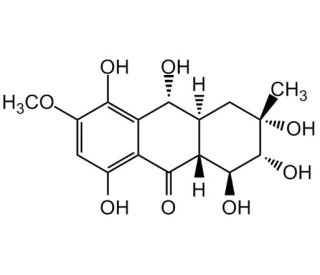

Tetrahydrobostrycin (CAS 1072119-07-3)
QUICK LINKS
Tetrahydrobostrycin is a chemical compound derived from the naturally occurring anthraquinone, bostrycin. It has garnered interest in the scientific community due to its unique structural modifications and the implications these have for its chemical behavior and interactions. Research on tetrahydrobostrycin has focused on its mechanism of action as an inhibitor of specific biochemical pathways in various organisms. One key area of investigation involves the compound′s ability to interfere with enzyme systems that are crucial for cellular processes. Studies utilizing techniques like enzyme kinetics and inhibition assays have explored how tetrahydrobostrycin affects these enzymes, providing insights into its mode of action at the molecular level. Additionally, tetrahydrobostrycin has been used in studies related to its redox properties. The compound′s ability to undergo redox reactions makes it a candidate for research in oxidative stress studies, where its capacity to influence oxidative pathways can be valuable. This research often involves the use of spectroscopic methods to track changes in the redox state of the compound and its interaction with other molecules.
Tetrahydrobostrycin (CAS 1072119-07-3) References
- Tetrahydrobostrycin and 1-deoxytetrahydrobostrycin, two new hexahydroanthrone derivatives, from a marine-derived fungus Aspergillus sp. | Xu, J., et al. 2008. J Antibiot (Tokyo). 61: 415-9. PMID: 18776653
- Alterporriol-type dimers from the mangrove endophytic fungus, Alternaria sp. (SK11), and their MptpB inhibitions. | Xia, G., et al. 2014. Mar Drugs. 12: 2953-69. PMID: 24840716
- Fungi as a Potential Source of Pigments: Harnessing Filamentous Fungi. | Kalra, R., et al. 2020. Front Chem. 8: 369. PMID: 32457874
- Hydroanthraquinones from Nigrospora sphaerica and Their Anti-inflammatory Activity Uncovered by Transcriptome Analysis. | Kuang, QX., et al. 2022. J Nat Prod. 85: 1474-1485. PMID: 35696541
- Application of Marine Microbial Natural Products in Cosmetics. | Ding, J., et al. 2022. Front Microbiol. 13: 892505. PMID: 35711762
- Chemical diversity, medicinal potentialities, biosynthesis, and pharmacokinetics of anthraquinones and their congeners derived from marine fungi: a comprehensive update. | Sebak, M., et al. 2022. RSC Adv. 12: 24887-24921. PMID: 36199881
Ordering Information
| Product Name | Catalog # | UNIT | Price | Qty | FAVORITES | |
Tetrahydrobostrycin, 1 mg | sc-364143 | 1 mg | $200.00 |